

Would this help me if I were the customer?
I rarely know how a page I am reading was made. I do know whether it helped me decide.
Summary Points
- AI slop is generic output. Nobody decided who it was for, nothing backs up its claims, and nobody checked if it helps.
- AI-augmented content starts with a person deciding who it is for and what they need to know.
- The same page can be made either way. The difference is the decisions around the draft, not the tool.
- One test covers it: who is it for, what supports the claims, what does it help the reader decide.
Reading time: 2 minutes
I rarely know how a page I am reading was made. I do know whether it helped me decide.
That is the test I would put to any AI-supported content before it goes out. Not "was this written by AI", which the reader cannot tell and mostly does not care about, but "would this help me if I were the customer".
What I mean by slop
AI slop is not a verdict on AI. It is a verdict on a process. The output reads smoothly and leaves the reader with nothing. It uses the words of the category and says nothing about this product, this customer or this decision.
The tell is that you could swap the brand name and nothing would change. That is what happens when a draft is produced without context and published without a check. It can happen with a human writer too. AI just makes it cheap to produce at scale.
Where augmented content starts
AI-augmented content starts somewhere else. A person decides who it is for and what they need to know. The brand's context and real evidence go in: the product facts, the approved claims, the questions customers actually ask. AI helps prepare the draft. People edit it and approve it.
None of that is new. It is what good editors have always done. What changes is that the drafting step is now fast and cheap, which means the deciding and checking steps carry more of the weight. If they are skipped, the output is slop, however good the model.
The same page, two ways
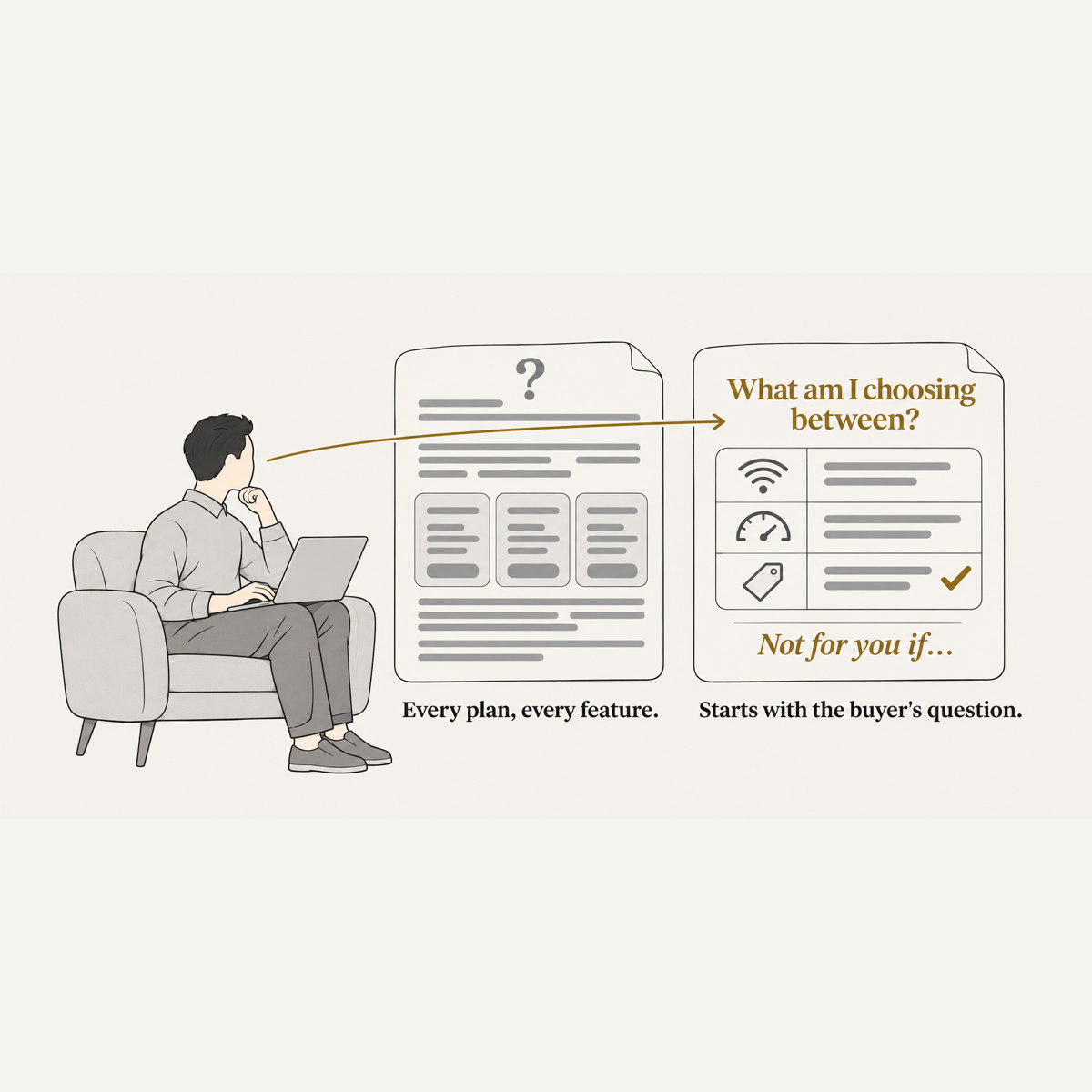
Here is an illustrative example. Two versions of the same broadband comparison page.
The first lists every plan and feature in confident, polished paragraphs. Speeds, bundles, introductory prices, all correct, all in the same even tone. It reads well. A buyer finishes it knowing no more about which plan to choose than when they started.
The second opens with the question the buyer is asking: what do I actually need? It sets out the trade-offs in a short table, says plainly when each plan is the wrong choice, and ends with who each option suits. It is shorter. It probably took longer to make, because someone had to decide what the reader needed.
AI could have helped with either. Only the second respects the reader's time.
The test, in three parts
Before anything goes out, I would ask three things.
- Who is it for? Not a segment name. A person with a question.
- What supports the claims? A source for every fact, and no fact without one.
- What does it help the reader decide? If the honest answer is "nothing", it is not ready.
A marketer can answer those in a minute. That minute is the difference between content and slop.
A page that helps a real person decide is the page worth having.
What check do you use before AI-supported content goes out?
Related Posts
Prompt, context, harness and agentic workflows: four layers of useful AI work
The prompt is the smallest part of AI work. The three layers under and around it decide whether the result is any good.
Read more →Humans + AI: connecting three dots in marketing
How we put AI to work, where a brand starts and what the customer receives belong in the same conversation about marketing.
Read more →