
Prompt, context, harness and agentic workflows: four layers of useful AI work
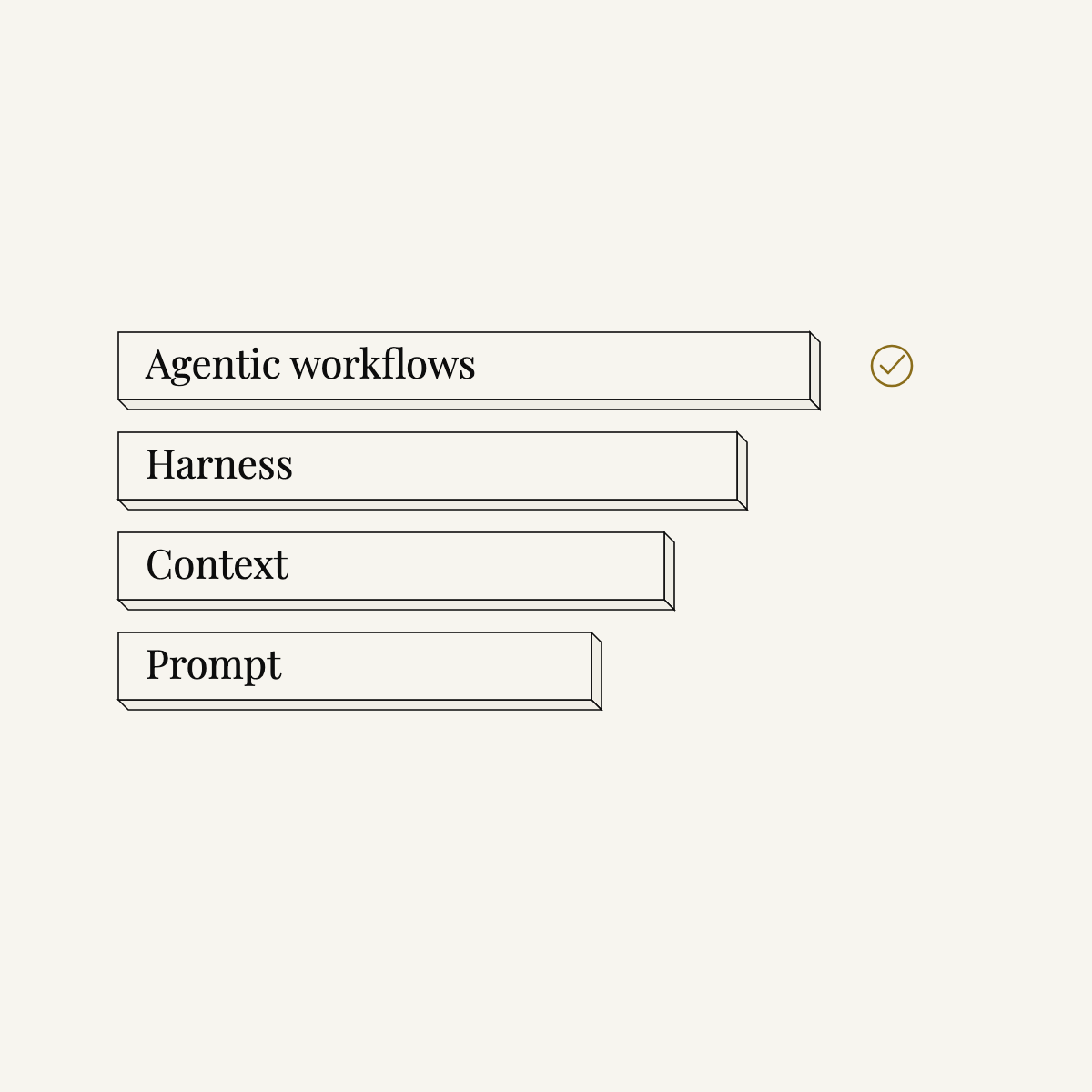
The prompt is the smallest part of AI work. The three layers under and around it decide whether the result is any good.
Summary Points
- A prompt only knows what you type into it. The other three layers give it what it needs.
- Context is the brand knowledge the work depends on. Thin context produces confident, generic output.
- A harness is the set-up around the model for one task: tools, context, prompts and which model does the work.
- An agentic workflow connects several tasks, with checks between them and a person approving before anything acts.
Reading time: 4 minutes
The prompt is the part of AI work everyone talks about. It is also the smallest part.
In my own builds over the last few months, useful AI work has needed four layers. Each one does something the layer before it cannot. When a result disappoints, the fault is rarely the prompt. It is usually a layer around it that was never built.
Prompt
The prompt is the instruction for one task. Write the post. Summarise the report. Draft the email.
It still matters. A clear instruction with the right constraints gets a better result than a vague one. But a prompt is a request, not a system. It knows nothing about your brand, your products or your past decisions unless something supplies them. Most of the effort I see go into "better prompting" is really an attempt to type the missing context in by hand, every time.
Context
Context is everything the work depends on: brand guidelines, product facts, standards, approved claims and the decisions already taken.
In April I wrote about keeping that context in four kinds of files, rules, a knowledge base, system docs and a changelog, so the AI does not start cold every session. Those files are the mechanics. This piece is about where context sits in the work as a whole. It is the second layer, and in my experience it is the one most teams skip.
The sign that context is thin is output that reads smoothly and says nothing specific. The model fills the gaps with averages. Nobody told it that your product has a twelve-week lead time, or that you never use the word "solution", so it guessed.
Harness
A harness is the set-up around the model for one task. It decides which tools the AI can use, which context it reads, which prompts it follows and which model does the work.
The word sounds technical, but the idea is plain. A harness is what turns "ask the AI" into a repeatable piece of work with the same inputs each time. The brief goes in the same way. The brand file is always attached. The product data comes from the live source, not from memory. The output lands in the same place for review.
Model choice belongs in this layer too. I wrote in April about matching the model to the task. A fast, cheap model for sorting and extraction. A stronger one for synthesis and judgement. A search model when the answer has to be current. That decision is part of the harness, not something to revisit every time someone types a prompt.
Agentic workflows
An agentic workflow is several of those tasks connected through AI agents, with checks between them and a person approving before anything acts.
The difference from a single task is the handoffs. One agent gathers the facts. Another drafts. A check compares the draft with the source. Then a person decides. Nothing publishes, sends or changes a live system without that approval. The workflow proposes; a marketer disposes.
This is the layer where most of the value sits, and the layer that fails worst when the ones below it are weak. A workflow built on thin context makes the same mistakes faster, and in more places.
Each layer depends on the one below it
Here is a simple illustrative example. A bakery wants a post about festive orders. Customers mainly want to know the last date to order.
- Prompt: write the festive orders post.
- Context: the menu, the last order date, collection times, and how the bakery talks to its customers.
- Harness: the order system supplies the date so it is never guessed, the brand file is always attached, and the task runs on a model suited to short copy.
- Workflow: the draft is checked against the order date and collection times, a marketer reads it and approves it, and only then is it scheduled. A reminder post nearer the date is a second task built on the same context.
Take any layer away and the post gets worse in a predictable way. No context, and the date is wrong. No harness, and the next post is prepared differently from the last. No workflow, and a draft goes out without anyone checking it.
The person at the top
No layer replaces the person who knows what good marketing looks like. The four layers decide how reliably the work is prepared. A marketer still decides what the work is for, whether it is right, and whether it goes out.
This is how we build workflows at Aurum AI Labs. We start with one task, build the context and harness around it, connect it into a workflow, and keep approval with the client's team.
Which layer is your team working on now?
Related Posts
Maintaining Context in Long AI Builds
Your AI does not forget. You are just not giving it the right memory. A four-layer system for maintaining context across every session.
Read more →Not All Models Are Built for Your Task
Using the most powerful model for every task is like hiring a consultant for every decision — a practical framework for matching models to tasks.
Read more →Humans + AI: connecting three dots in marketing
How we put AI to work, where a brand starts and what the customer receives belong in the same conversation about marketing.
Read more →