

Not All Models Are Built for Your Task
Using the most powerful model for every task is like hiring a consultant for every decision — a practical framework for matching models to tasks.
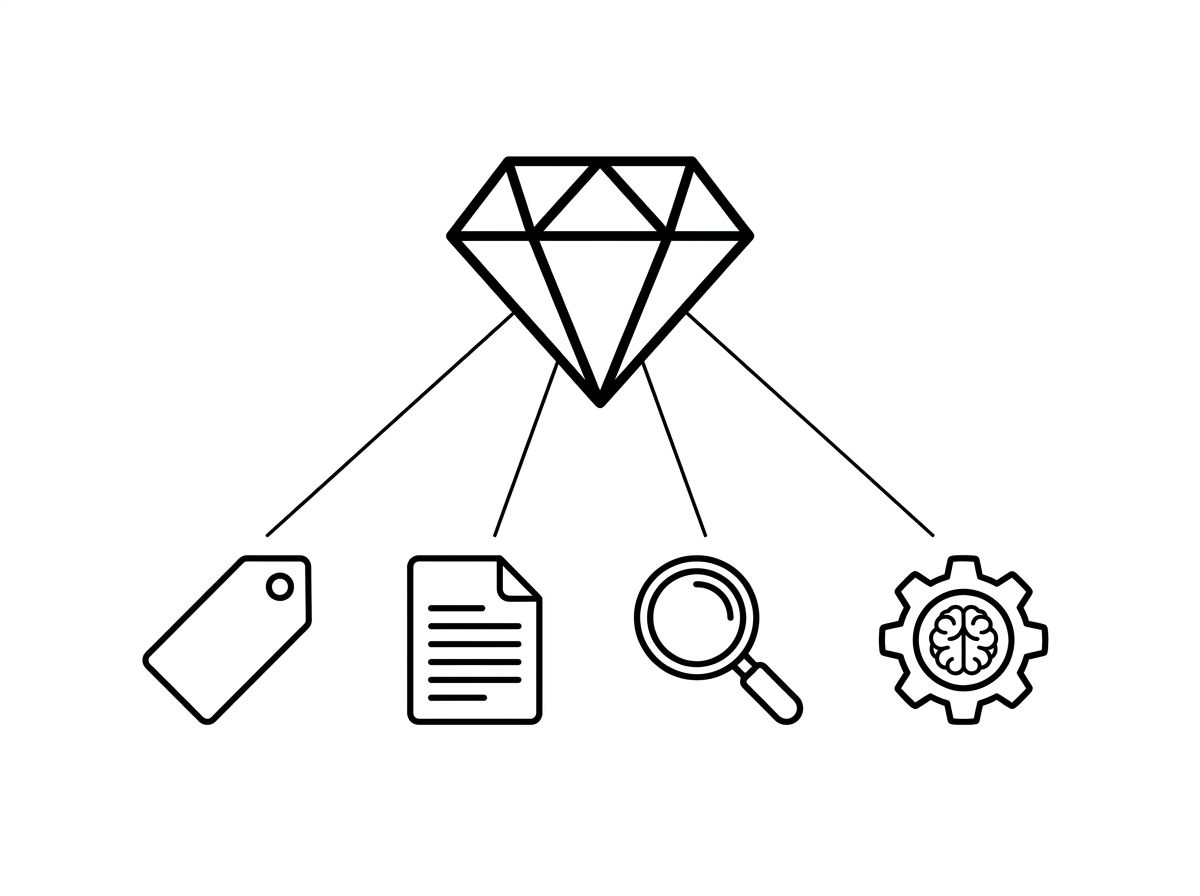
Summary Points
- One model for everything is the most common and most expensive mistake AI builders make
- Models differ on five dimensions that matter: reasoning depth, speed, cost, context window, and retrieval
- Four task tiers — reasoning, mid-tier, lightweight, and search — each with a clear decision rule
- The skill is not knowing the most powerful model — it is knowing which one fits the task
Reading time: 6 minutes
Using the most powerful model for every task is like hiring a consultant for every decision. Sometimes you just need a calculator.
Most builders pick a model once and use it for everything.
They find one that works — Claude, GPT, Gemini — and route every task through it. Content generation. Code review. Data analysis. Summarisation. Architecture decisions. The same model, the same tier, the same cost — regardless of what the task actually demands.
It works. Until the invoice arrives. Or until the output quality drops and they cannot figure out why.
The problem is not the model. The problem is the assumption that one model fits every task. It does not. Different models are built for different cognitive demands — reasoning depth, speed, cost, context length, retrieval. Choosing the wrong one does not just waste money. It produces worse output.
Model selection is not a set-and-forget decision. It is a recurring judgment call — and most builders are not making it.
Before choosing a model, you need to understand what you are choosing between. Models differ on five dimensions that matter for real work:
Reasoning depth — how well a model handles multi-step logic, architectural decisions, ambiguous trade-offs. Some models think deeply. Others pattern-match quickly.
Speed — how fast the response arrives. For interactive work — code completion, quick lookups, in-editor suggestions — latency matters more than depth.
Cost — the price per million tokens, input and output. A 10× cost difference between tiers is real when you are running thousands of calls a day.
Context window — how much information the model can hold in a single conversation. Some tasks need 8K tokens. Others need 200K.
Retrieval and grounding — whether the model can access real-time information or is limited to its training data. For research, competitive analysis, and market intelligence, this is the difference between useful and outdated.
Every model makes trade-offs across these five. The most powerful model is not the best model — it is the most expensive one deployed in the wrong place.
Here is how I think about it. Not by model name — those change every quarter. By task type and what the task actually requires.
Tier 1 — Deep Reasoning and Complex Analysis
Architecture decisions. Multi-step debugging. System design. Strategic analysis where the AI needs to hold conflicting constraints and reason through trade-offs.
This is where you need the most capable model available — Claude Opus, o3, Gemini Pro with extended thinking. These models think longer, reason deeper, and handle ambiguity better. They cost more. They are worth it — for this tier.
The decision rule: if the task requires judgment, not just generation, use a reasoning-tier model.
Tier 2 — Writing, Synthesis, and Content Production
Blog posts. Marketing copy. Report synthesis. Code generation for well-defined tasks. Summarisation of large documents.
This is where mid-tier models excel — Claude Sonnet, GPT-4o, Gemini Flash. They are fast, capable, and dramatically cheaper than reasoning-tier models. For most content and code generation, the quality difference between Sonnet and Opus is negligible. The cost difference is not.
The decision rule: if the task has clear instructions and a defined output format, a mid-tier model handles it as well as a top-tier one — at a fraction of the cost.
Tier 3 — Fast, Lightweight Tasks
Classification. Tagging. Extraction. Validation. Quick format conversion. Any task where the cognitive demand is low and the volume is high.
This is where small, fast models shine — Claude Haiku, GPT mini, Gemini Flash Lite. They respond in milliseconds, cost a fraction of a penny per call, and handle structured tasks with precision. Routing these tasks to a reasoning model is not just wasteful — it is slower.
The decision rule: if a junior analyst could do it in under a minute, a lightweight model can do it in under a second.
Tier 4 — Search-Augmented and Real-Time Tasks
Market research. Competitive monitoring. Fact-checking against current data. Any task where the answer depends on information published after the model's training cutoff.
Standard models cannot do this — they are frozen in time. Search-augmented tools like Perplexity, ChatGPT with search, or Gemini with grounding access live data, cite sources, and return current answers.
The decision rule: if the answer could have changed since last month, use a tool with real-time retrieval.
This is not theoretical. The cost difference between model tiers is significant enough to change the economics of what you build.
In production systems, the gap between a reasoning-tier model and a mid-tier model is typically 5–15× per million tokens. Between mid-tier and lightweight, another 5–10×. Run a thousand calls a day through the wrong tier and the waste compounds.
But cost is only half the equation. Speed matters too. A reasoning-tier model that takes 30 seconds per response is wrong for an interactive code assistant. A lightweight model that returns in 200 milliseconds is wrong for an architecture review.
The builders who scale AI-assisted work are not the ones who found the best model. They are the ones who built a multi-model architecture — routing each task to the tier that fits its cognitive demand, speed requirement, and cost tolerance.
In my own builds, a single workflow might touch three different model tiers. A lightweight model handles extraction and classification. A mid-tier model synthesises the results into a structured analysis. A reasoning-tier model reviews the final output for quality and coherence. Each model does what it is best at. None of them does everything.
That is not over-engineering. That is the difference between a prototype and a production system.
When choosing a model for a task, ask three questions:
1. What is the cognitive demand?
Does this task require reasoning, judgment, and handling ambiguity? Or is it structured, predictable, and well-defined? The answer determines the tier.
2. What is the speed requirement?
Is the user waiting for this response? Is it part of an interactive workflow? Or is it a background job where latency does not matter? The answer determines whether you optimise for speed or depth.
3. What is the acceptable cost per call?
Is this a one-off analysis or a task that runs thousands of times per day? The answer determines whether top-tier cost is justified or whether a cheaper model delivers the same result.
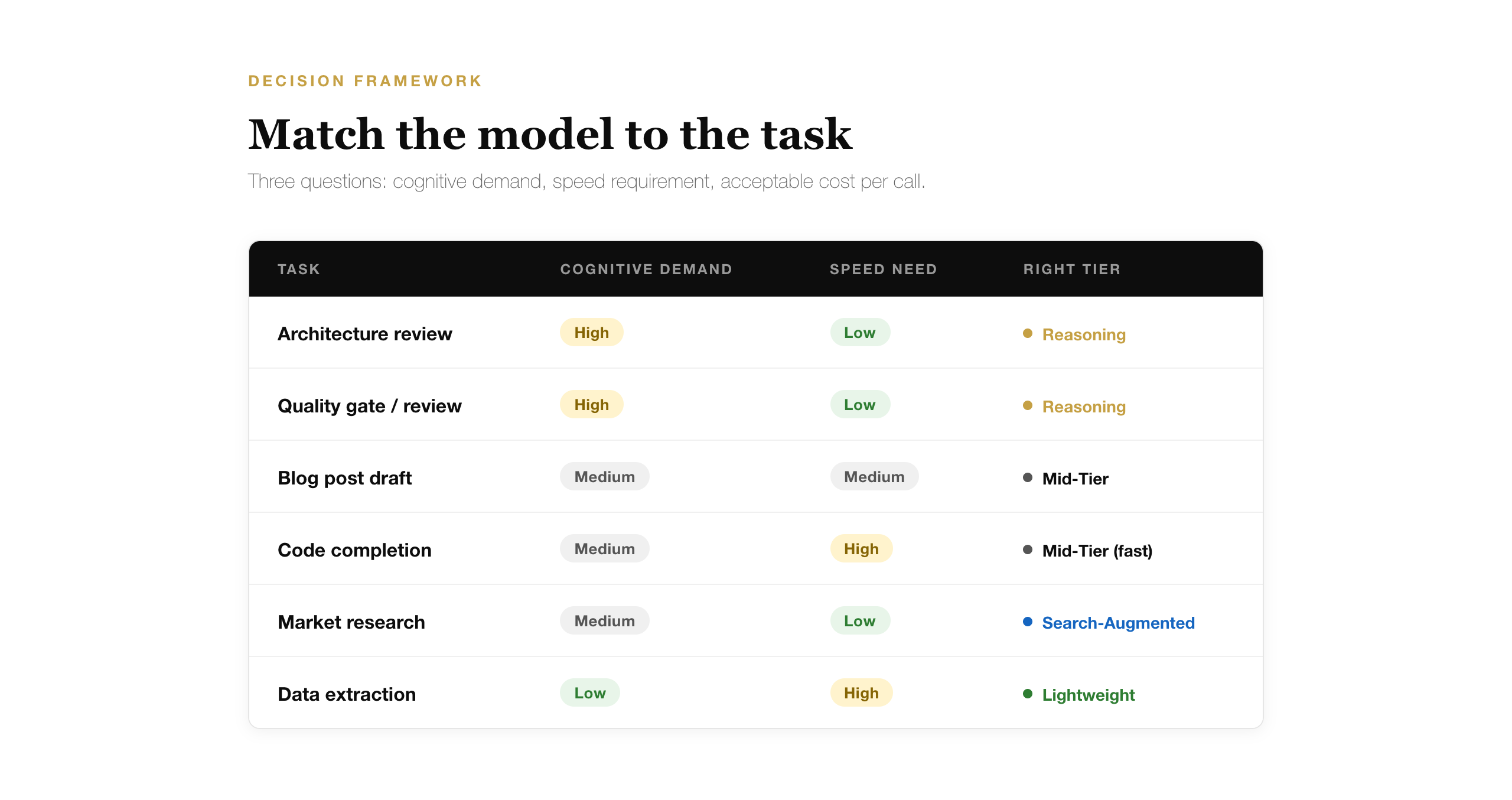
The model name does not matter. The tier match does.
The AI industry wants you to believe that bigger is always better. That the most powerful model is the right model. That capability is the only dimension worth optimising for.
It is not. Capability without context is waste. A reasoning-tier model classifying tags is a consultant sorting mail. A lightweight model reviewing architecture is a calculator solving calculus. Both fail — in opposite directions.
The skill is not knowing which model is the most powerful. The skill is knowing which model fits the task in front of you — and having the discipline to route accordingly.
Model selection is not a technical decision. It is a thinking decision.
Connect on LinkedIn → Yogesh Kothari
Related Posts
Maintaining Context in Long AI Builds
Your AI does not forget. You are just not giving it the right memory. A four-layer system for maintaining context across every session.
Read more →Vibe Coding Is Not About the AI. It's About You
Better prompts were never the answer. Better thinking was. The 4 human skills that separate builders who ship from builders who spiral.
Read more →