

Customer-Centric Modern Marketing Stack
Explore the essential components of a modern marketing stack, focusing on the CDP and CEP as the core pillars.
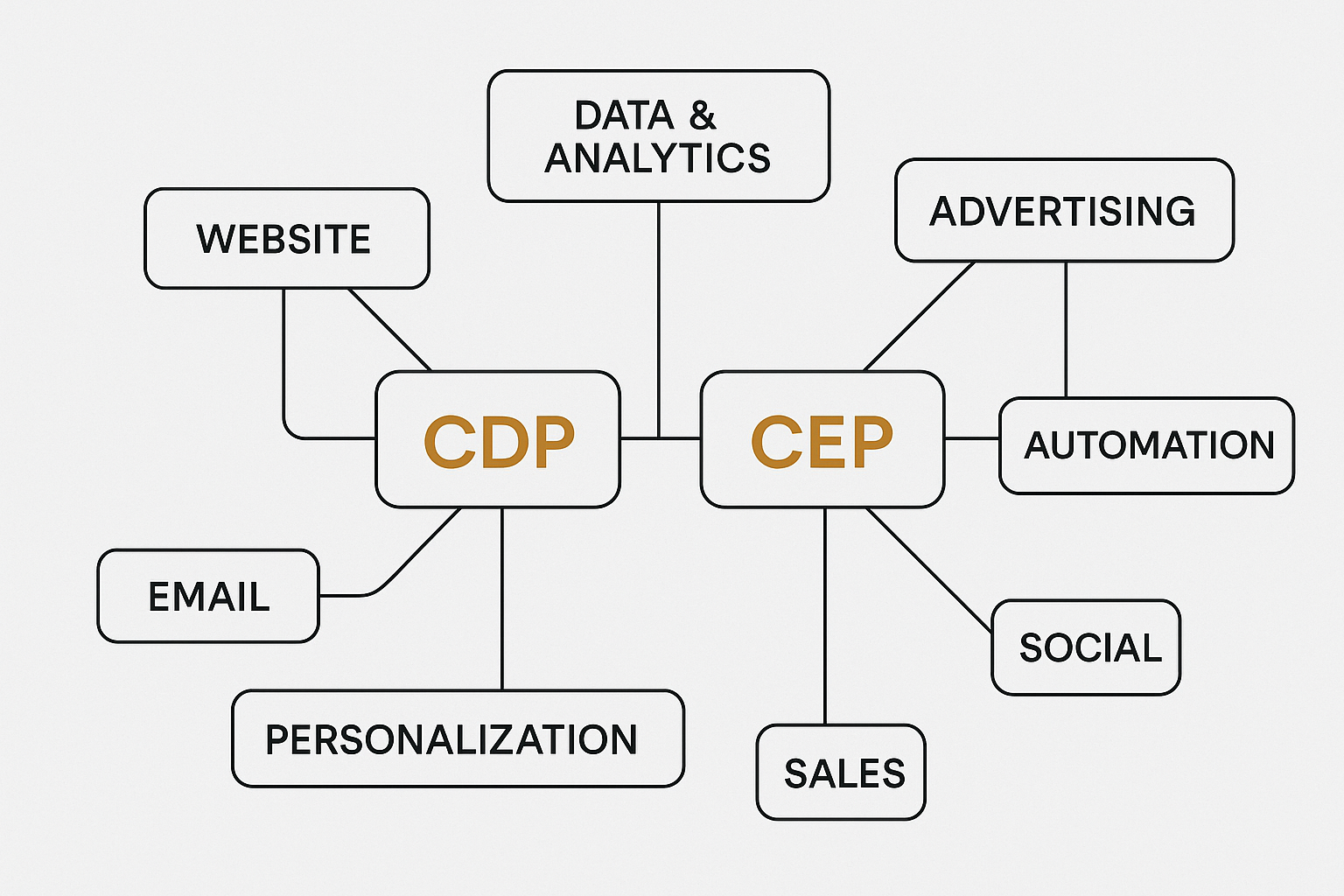
Summary Points
- Modern marketing stacks need two pillars: CDP (data hub) and CEP (engagement engine) working together
- CDP Intelligence Hub: Unifies customer data from all sources into golden profile, for 360° customer view
- CEP Activation Engine : Turns CDP insights into real-time cross-channel personalized journeys
- Integrated Ecosystem: CRM, analytics, CMS, etc. are important with seamless data flow
Reading time: 6 minutes
Introduction: Building the Customer-Centric Core
In today's world, marketing isn't just about sending out messages; it's about truly understanding your customer and engaging with them intelligently, no matter where they are. A truly modern marketing stack, one that puts the customer at the centre, is built around this idea. It's more than just a random collection of shiny tools; it has a clear structure, with central pillars that hold everything together.
At the heart of this customer-centric stack are two primary components. Think of them as the foundational pillars that enable everything else. We'll explore what these are and how they work together with other essential pieces to create a powerful, interconnected system.
Pillar 1: The CDP - Your Customer Intelligence Hub
The first of these pillars is the Customer Data Platform (CDP). If you're going to understand your customer deeply, this is where it starts. The CDP is the foundational layer, acting as the intelligence and data hub for your customer information.
Its core job is to take customer data from all your connected sources – think CRM, website, mobile app, service desk, etc. – ingest it, unify it, clean it up, and consolidate it into a single, persistent, and comprehensive customer profile. This creates what's often called the "golden record" for each individual. It's the central "data resident," providing that crucial 360-degree view of your customer. The CDP's power lies in consolidating information that often sits in totally separate, siloed systems, creating a single source of truth for your customer data.
You may have heard of examples like Segment, Tealium AudienceStream, mParticle, or the customer data platforms (CDPs) offered within larger suites, such as Adobe Experience Platform (AEP) CDP or Salesforce Data Cloud.
Why is the CDP main? Plain and simple, without a unified, accessible, and robust view of the customer that the CDP provides, truly personalised and data-driven marketing is impossible to achieve at scale. The CDP provides the necessary intelligence and the solid foundation of understanding required for literally everything that comes next – all your subsequent engagement, analysis, and strategic decision-making.
Pillar 2: The CEP - Your Activation & Orchestration Engine
Having all that fantastic, unified customer data in your CDP is incredibly valuable, but data sitting still doesn't do much on its own. That's where the second pillar comes in: the Customer Engagement Platform (CEP).
Think of the CEP as the engine for activation and orchestration. This is the platform that takes the rich, unified customer data and segments that the CDP has built, and puts them into action. The CEP enables marketers like us to create, automate, and orchestrate personalised customer journeys, multi-channel campaigns, and even real-time interactions across various channels. It's the tool that triggers communications and experiences, such as sending an email, pushing a notification, or personalising a website message, based directly on customer profiles, segments, behaviour, and journey stage, as identified using data from the CDP.
Examples of CEPs include platforms such as Braze, Clevertap, MoEngage, Salesforce Marketing Cloud, Adobe Journey Optimiser
Why is the CEP main? The power of exceptional customer data in a CDP is only fully realised when it's used to drive meaningful interactions. The CEP is the engine that leverages this intelligence to execute those personalised engagement strategies, automate complex communication workflows, and deliver relevant, timely, and connected experiences across the entire customer lifecycle.
The Supporting Cast: Enabling, Enriching, and Optimising
We have two main pillars: the CDP for understanding and the CEP for action. But they don't work alone. A truly effective modern marketing stack includes a range of essential supporting components. Think of these as the vital "supporting cast" that brings out the best in the leading actors.
These components are crucial for several key reasons: they provide the data to the pillars, they enable the specific Channels through which engagement happens, and they provide the necessary tools to measure, analyse, and drive Optimisation across the entire marketing process. They significantly enhance the capabilities of both the CDP and the CEP.
We're talking about tools such as your CRM, web and app analytics platforms, CMS, data analytics and visualisation tools, data lakes or warehouses, advertising platforms, email and messaging tools, social media platforms, experimentation tools, and attribution modelling tools.
Key Supporting Components (Role & Support)
Let's break down some of these key supporting components and understand their role and how they help our CDP and CEP pillars:
- CRM (Customer Relationship Management)
- Role: Core customer data source (contact, demo, sales, service).
- Support: Feeds foundational data into the CDP for a single customer view.
- Web and App Analytics Platform
- Role: Behavioural data sources (user actions, clicks, paths).
- Support: Feeds behavioural signals into the CDP, enriching profiles and enabling real-time segmentation in the CEP.
- CMS (Content Management System):
- Role: Holds website/blog content, may personalise content.
- Support: CDP/CEP can trigger the display of personalised content, and CMS can feed back content interaction data.
- Data Analytics & Visualization:
- Role: Analyse performance, build dashboards.
- Support: Consumes data from CDP/CEP to report on campaign effectiveness and overall marketing impact.
- Data Lake/Warehouse:
- Role: Centralised storage for large-scale, raw data.
- Support: feed data into the CDP, or the CDP can feed its unified profiles out to the warehouse for broader business intelligence.
- Advertising Platforms:
- Role: Execute paid media campaigns (Google Ads, Meta, etc.).
- Support: CDP segments are pushed to ad platforms for targeting (custom audiences), and campaign performance data is ingested back into the CDP and analytics.
- Email/Messaging/Push Tools (sometimes part of CEP):
- Role: Deliver communications.
- Support: Executed by the CEP based on customer data and journey logic.
- Experimentation A/B Testing Tools:
- Role: Optimise messaging, landing pages, and user flows.
- Support: Integrates with CEP/CMS to test variations, results feed back into the CDP/analytics for learning.
The Importance of Integration
It's crucial to understand that the power of this modern stack lies in how well these different components communicate with each other. Integration is key: The primary objective is to ensure data flows smoothly between systems.
Your web analytics need to be integrated with your CDP. Your CDP needs to feed unified profiles and segments into your CEP and your advertising platforms. Your CEP needs to trigger actions across various channels (email, push, in-app, etc.) and potentially update the CRM or CDP with engagement data. Your analytics tools need to pull data from everywhere to provide a comprehensive view of what's working. Without solid integrations, you end up with more silos, which is precisely what the CDP is meant to solve in the first place!
Conclusion: Building for the Future
Building a truly modern, customer-centric marketing stack means moving beyond just collecting tools. This involves strategically designing a system with the CDP serving as the intelligence hub and the CEP as the activation engine. These two core pillars, supported by well-integrated specialist tools for data collection, channel execution, and analytics, form the foundation for a deep understanding of your customers and effective engagement with them across their entire journey.
This structure isn't static, of course. The specific tools might change, and new categories might emerge. But the core principle remains: build around a unified view of the customer (CDP) and a powerful engine to act on that understanding (CEP). That's how you create a marketing machine built for sustainable growth and genuine customer relationships in the modern era.
Related Posts
3Cs of Customer Engagement: Customer, Channel, and Communication
Explore the 3Cs framework (Customer, Channel, Communication) for building stronger customer relationships, powered by essential Measurement & Governance.
Read more →Composable-CDPs: Building Fast & Modular Stack
The customer data platform landscape is shifting from monolithic systems to flexible, warehouse-centric Composable CDPs.
Read more →