

3Cs of Customer Engagement: Customer, Channel, and Communication
Explore the 3Cs framework (Customer, Channel, Communication) for building stronger customer relationships, powered by essential Measurement & Governance.
Summary Points
- Customer-centric engagement through: Customer profiles, Omni-channel journeys, & Effective communication
- Governance and analytics drive strategy - clean data, campaign tracking, dashboards, & control groups prove real impact
- Build rich profiles using purchase history, RFM analysis, CLTV, and feedback - enabling hyper-personalized engagemen
- Connect channels and optimize messaging through A/B testing, geographic personalization, and preference-based delivery
Reading time: 5 minutes
Introduction: Building Stronger Connections through the 3Cs
In today's dynamic market, building lasting relationships with your customers is paramount. It's not just about the initial handshake of acquisition, but about nurturing those connections so customers don't just stay, but become loyal advocates for your brand. But how do you create a truly effective customer engagement strategy that goes beyond just sending out emails?
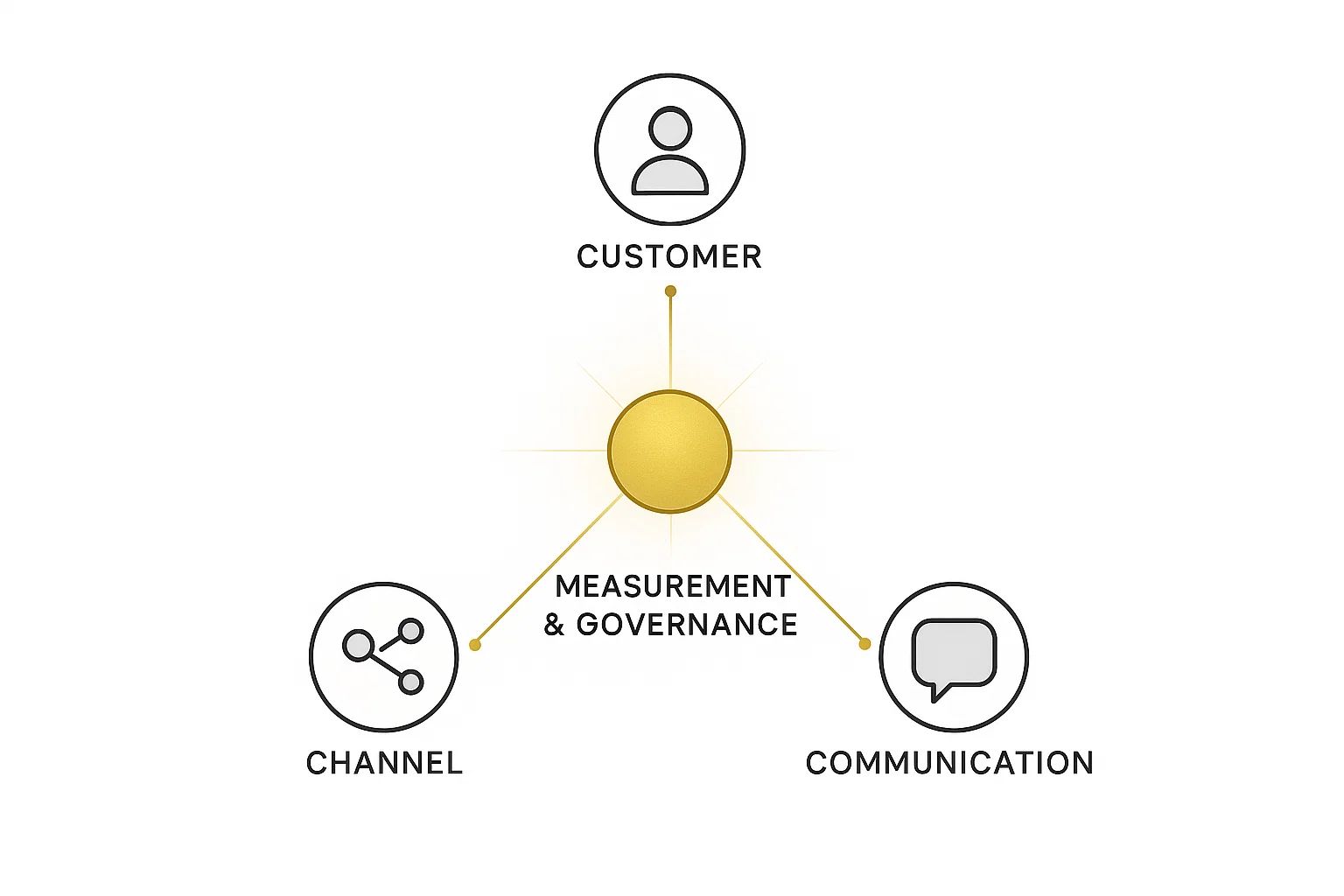
The answer lies in a holistic approach that consistently puts the customer at the centre. I have outlined a robust framework we call the "3Cs," which stand for Customer, Channel, and Communication. With Measurement & Governance acting as the central pillar, this framework ensures your engagement efforts aren't just busywork, but are strategic, practical, and constantly optimised based on real results. Let's break down this approach and see how these pieces fit together.
Measurement & Governance: The Central Engine
Before we even get to the "Cs," we need to discuss the engine that powers them: Measurement and Governance. Think of this as the non-negotiable foundation. It's where you track performance, gain crucial insights, and ensure your data is clean and compliant.
Why is it central? Because it ensures your efforts are strategic, effective, and optimised. Without solid M&G, you're flying blind. It covers key aspects like:
- Data Clean Up: Ensuring accurate customer data (Name, Email, Mobile No, Zip Code/Address).
- Campaign Naming/Tracking: Consistent naming and tracking for accurate attribution.
- Custom Dashboard with Benchmark & Filtering: Tracking key metrics, benchmarking, and filtering data for deeper analysis.
- Control Group to Measure Incrementally/Lift: Truly Understanding the Incremental Impact of Your Efforts.
This is the backbone that supports everything else.
The Three Cs: Pillars of Engagement
At the heart of this framework are three interconnected components, the "3Cs." These are the pillars of your engagement strategy, and they work together seamlessly, powered by that central Measurement & Governance engine we just discussed.
Let's dive into each one.
C1: Customer Profile & Segmentation: Knowing Your Audience
This is the foundational "C," focusing on the Customer. You can't engage effectively if you don't truly understand who you're talking to, at a deep and nuanced level. This goes way beyond basic demographics. It's about building rich, insightful customer profiles, capturing their interactions, preferences, behaviours, and needs.
- It starts with a solid Customer Data Plan – actively defining and collecting relevant data from all touchpoints (attributes like purchase history, loyalty status, and dynamic events like website clicks, app sessions).
- Then, it's about Leveraging Data for deeper insights. Utilise data for predictive models, such as Product Propensity (identifying likely buyers for cross-sell or upsell, e.g., recommending headphones to someone who has purchased a phone) and RFM analysis (segmenting customers based on Recency, Frequency, and Monetary value for winback or retention strategies).
- Also, focus on offers based on CLTV – tailoring offers to estimated Customer Lifetime Value to maximise ROI (e.g., offering a special discount to a high-CLTV customer).
- Finally, gather direct feedback through survey campaigns and partner monitoring for sentiment and journey integrity (e.g., sending a post-purchase survey or monitoring reviews on partner sites).
C2: Omni-Channel Journeys: Seamless and Connected Experiences
The second "C" focuses on the Channel. Customers today don't stick to just one channel. They interact everywhere – on websites, apps, social media, email, SMS, and in physical stores. An effective framework ensures these interactions aren't siloed but form a connected, seamless journey, regardless of the Channel.
- This means creating holistic and structured journeys. Map the entire customer journey (e.g., from initial ad click to repeat purchase), identifying touchpoints and transitions across different Channels. Design a consistent experience (e.g., same brand voice and offerings) across all channels.
- Pay close attention to Customer Channel Preference & Fatigue – understand preferences (e.g., does this customer prefer SMS or email?) and avoid bombardment (e.g., don't send multiple messages across different channels for the same event).
- Integrating Channels like WhatsApp can offer direct, personalised communication if preferred (e.g., sending shipping updates or personalised offers via WhatsApp*).
C3: Effective Communication: Delivering the Right Message, at the Right Time
The third "C" is all about Communication. Even with deep customer understanding (C1) and a seamless journey (C2), engagement fails without effective Communication. Deliver the right message, the right way, at the right moment.
- It requires mastering Best Practices across different formats – understanding nuances for email (subject lines, calls to action), SMS (conciseness), in-app notifications (timing), social posts (visuals, tone), push notifications (urgency), etc.
- Constant A/B Testing is non-negotiable – test messaging (e.g., "Save 10%" vs. "Get 10% off"), subject lines, calls to action, visuals, timing to optimise engagement.
- Geographics Personalisation – Tailor Communication based on location (e.g., promoting a local store event or using region-specific language and references).
Measurement & Governance Deep Dive: The Engine of Improvement
Let's circle back to Measurement & Governance, because its practical application makes the 3Cs truly powerful and ensures results. This is the central engine for continuous improvement and accountability.
It focuses on details for reliable data and measurable efforts.
- This includes rigorous Data Clean-up – ongoing processes for accurate data (Name, Email, Mobile Number, Zip Code/Address, etc.) to ensure understanding (C1) is based on truth.
- Use systematic Campaign Naming with tagging and tracking across channels (e.g., naming conventions like "Promo_SummerSale_Email_SegmentX") to accurately attribute results, conversions, and revenue.
- Rely on Custom Dashboards with Benchmark & Filtering for a clear overview of key metrics (e.g., tracking email open rates vs. industry benchmarks, filtering web traffic by source).
- Crucially, use Control Groups to Measure Incrementality/lift and understand the causal impact and ROI (e.g., sending a winback campaign to a test group and comparing their repurchase rate to that of a control group that didn't receive the campaign).
Conclusion: The Power of the 3Cs + M&G
So, there you have it – the 3Cs customer engagement framework, powered by robust measurement and governance. It provides a clear roadmap for building stronger, more profitable customer relationships.
By focusing on a deep understanding of your Customer (C1), creating seamless experiences across every Channel (C2), and communicating effectively (C3) – all while rigorously measuring and optimising efforts (M&G) – you foster loyalty, drive growth, and create advocates. Implementing this requires commitment to data, technology, and a customer-centric mindset, but the rewards are well worth the effort.
Related Posts
Composable-CDPs: Building Fast & Modular Stack
The customer data platform landscape is shifting from monolithic systems to flexible, warehouse-centric Composable CDPs.
Read more →Customer-Centric Modern Marketing Stack
Explore the essential components of a modern marketing stack, focusing on the CDP and CEP as the core pillars.
Read more →