

Composable-CDPs: Building Fast & Modular Stack
The customer data platform landscape is shifting from monolithic systems to flexible, warehouse-centric Composable CDPs.
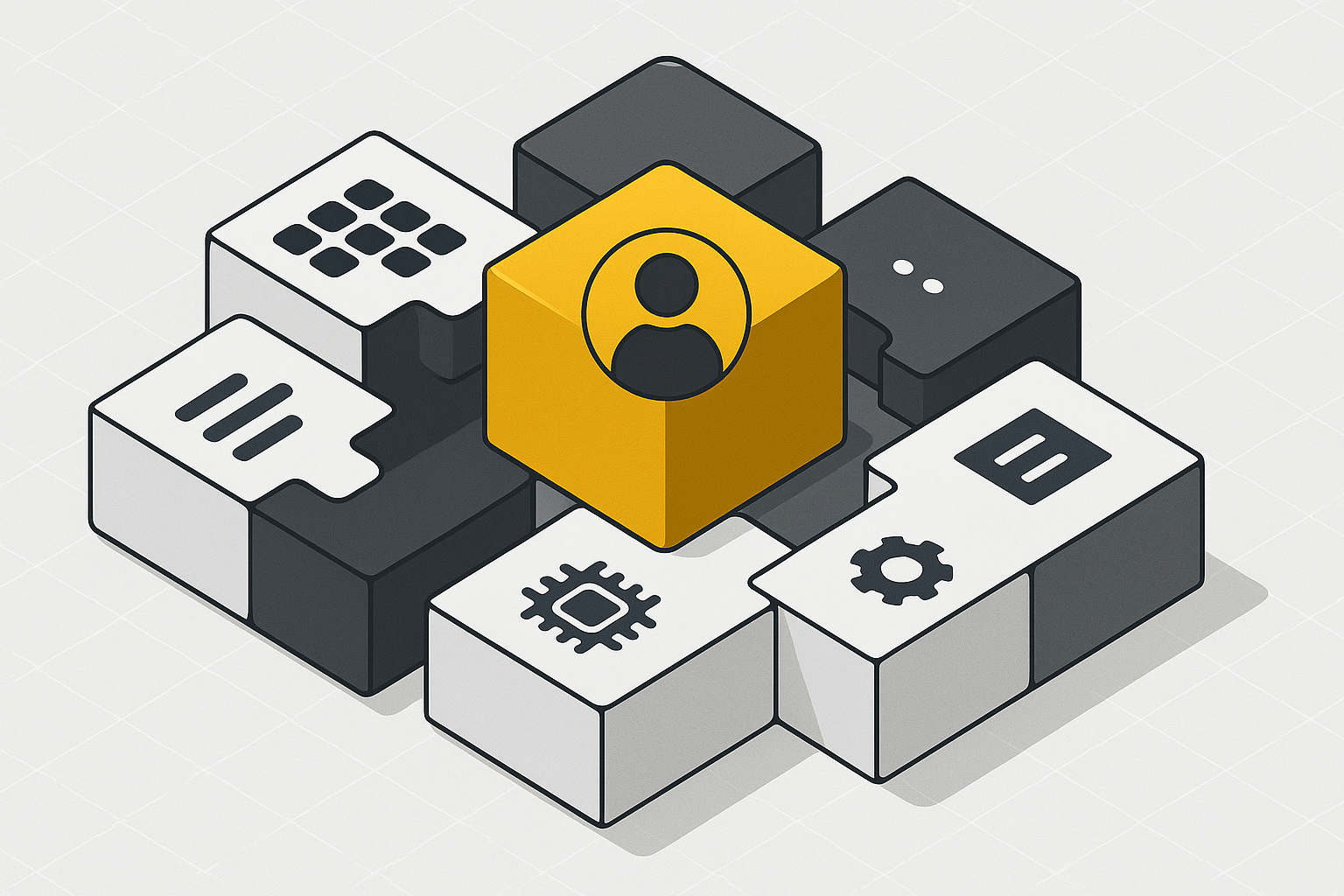
Summary Points
- Traditional CDPs face limitations; modern approach uses modular, warehouse-native tools for flexibility and control
- Eliminates data duplication, reduces vendor lock-in and leverages existing warehouse investments
- Requires strong data governance, technical skills, and cross-team collaboration to avoid integration complexity
Reading time: 12 minutes
The Customer Data Landscape is Shifting
If you work with customer data, you've likely noticed things are changing fast. The way we collect, manage, and activate information about our customers is undergoing a fundamental transformation. For years, the go-to solution was often the traditional, all-in-one Customer Data Platform (CDP). These platforms certainly played a valuable role in centralising data. However, as our data grows larger, our needs become more complex, and the technology landscape evolves, a new model is taking centre stage: the Composable CDP.
What exactly does this shift mean? Why is it happening now? And perhaps most importantly, what are the real-world benefits, challenges, and strategic implications for businesses like yours? This post aims to unpack the Composable CDP, exploring its architecture, advantages, and how organisations are leveraging this flexible approach to build faster, more modular, and ultimately more effective customer data stacks. Let's dive in.
What Exactly Is a Composable CDP?
At its core, a Composable CDP isn't a single piece of software, but rather a modern strategy for customer data management. It’s built on two key principles: modularity and warehouse-centricity.
Modularity: Instead of buying a single, bundled platform with potentially unnecessary features ("shelfware"), the composable approach enables you to select and integrate distinct, best-in-class tools for specific functions, such as data collection, identity resolution, audience segmentation, and activation. You essentially "compose" your CDP stack based on your unique needs.
Warehouse-Centricity: This is the game-changer. A true Composable CDP leverages your existing cloud data warehouse (such as Snowflake, Google BigQuery, Databricks, or Amazon Redshift) as the central data repository and foundation. Unlike traditional CDPs, which often copy your data into their separate storage, the composable model operates directly on top of the data already residing securely within your warehouse.
This warehouse-native approach is crucial. It means:
No Data Duplication: You avoid the cost, complexity, and potential inconsistencies of maintaining multiple copies of customer data . Your warehouse remains the single source of truth.
Leveraging Investment: You capitalise on the significant investments you've likely already made in your cloud data infrastructure.
Generally, to qualify as truly composable, an architecture should meet these criteria :
- Operates on your data warehouse infrastructure without storing persistent copies elsewhere.
- It is Schema-Agnostic, meaning you control how your data is structured, not the vendor.
- It is Modular and Interoperable, integrating smoothly with your tech stack via APIs.
Think of it this way: a traditional CDP might be like buying a pre-packaged meal – convenient, but maybe not exactly what you wanted or needed. A Composable CDP is like having a well-stocked kitchen (your data warehouse), where you select the best individual appliances (specialised tools) to cook the meal you desire precisely.
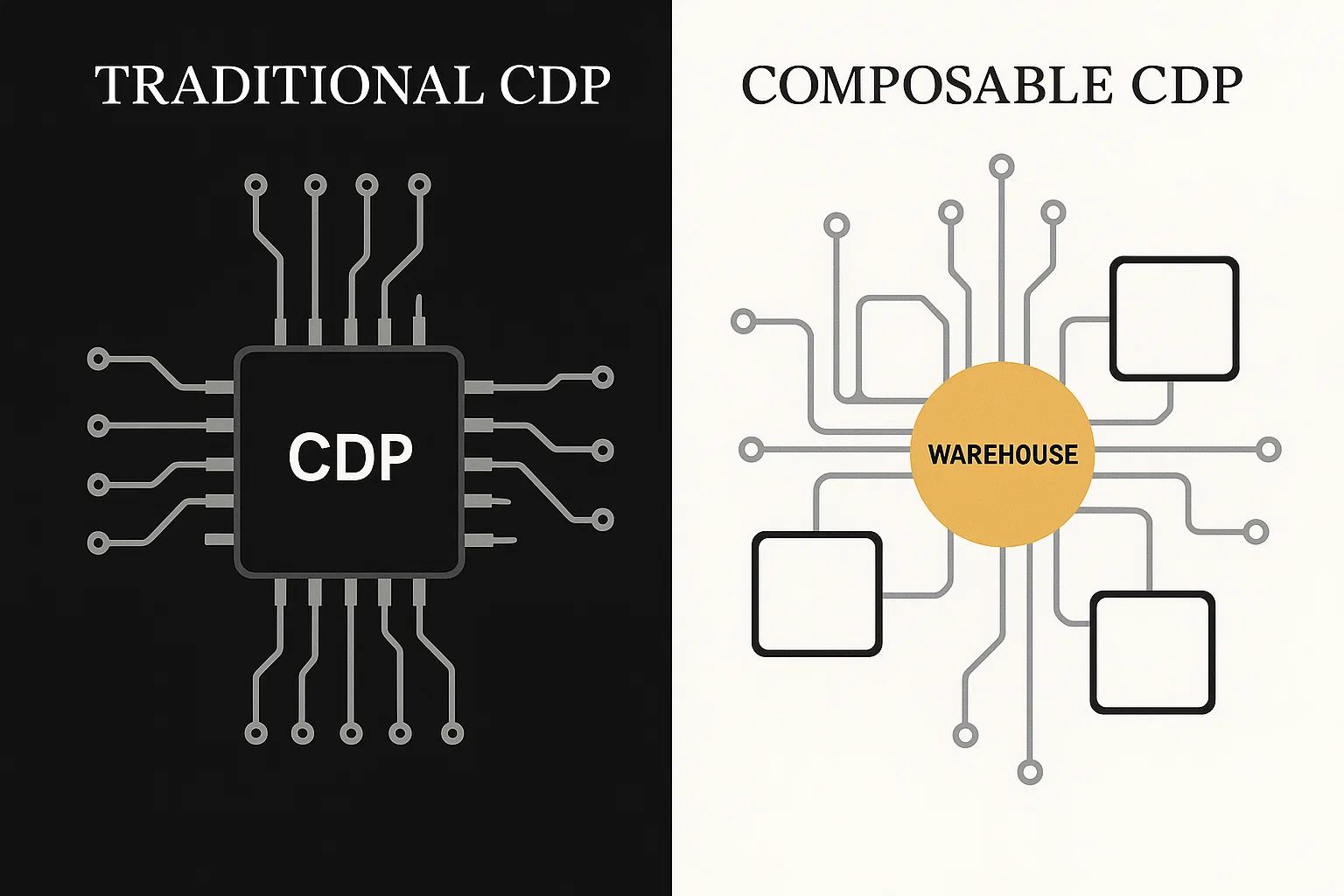
The difference becomes clear when you compare architectures side-by-side:
Traditional Monolithic CDP: An all-in-one box. Data is ingested, copied to an internal database, processed, and activated from within that vendor-controlled system. Integration can sometimes be rigid.
Composable CDP: A collection of specialised tools orchestrated around your data warehouse. Data flows into the warehouse, processing occurs there, and activation tools query the warehouse to send data out. Integration is at the core of the design.
This leads to fundamental differences in flexibility (higher with composable, lower with traditional), control (where you own the data and logic with composable), and the risk of vendor lock-in (which is lower with composable).
The Shift: Why Now? Why Composable?
This evolution isn't happening in a vacuum. Several powerful forces are converging to drive the move towards composability. Many of us in the industry felt the growing pains with earlier approaches.
1. Limitations of Traditional CDPs: While valuable initially, monolithic platforms began to show cracks as data scaled and required specialised solutions. Organisations faced:
- Rigidity: Difficulty adapting to unique business logic or data models.
- Scalability Hurdles: Performance bottlenecks tied to vendor infrastructure.
- Integration Challenges & Lock-in: Complex connections and difficulty switching tools.
- Data Duplication & Silos: Ironically, this creates another data silo and increases costs.
- Limited Data Scope: Often struggled to access the full breadth of enterprise data beyond web/mobile.
- Slow ROI: Lengthy implementations (6- 12+ months) often fail to deliver the expected value. Do you think this sounds familiar to you?
2. The Rise of the Cloud Data Warehouse: Simultaneously, platforms such as Snowflake, BigQuery, and Databricks have matured into incredibly powerful, scalable, and cost-effective hubs for all enterprise data. They became the strategic single source of truth. This created a conflict: why maintain a separate, often incomplete, CDP data store when the definitive data lives in the warehouse? . The Composable CDP resolves this by building on the warehouse, not beside it.
- Catalysing Market Trends: Several key trends are pouring fuel on the fire:
- Heightened Data Privacy: The GDPR, CCPA, and the end of third-party cookies require greater control and robust first-party data strategies, which are easier to manage when data remains within your governed warehouse.
- Demand for Agility: Businesses must adapt quickly to stay competitive. Modularity enables quicker iteration and adoption of new tools.
- AI & Advanced Analytics: Effective AI needs access to complete, high-quality data. The warehouse provides this foundation; composable tools activate it seamlessly.
- Cost Optimisation: Unbundled pricing and eliminating redundancy align with the pressure to prove MarTech ROI.
- Shift in Tech Ownership: Data and IT teams are increasingly influencing CDP decisions, favouring solutions that integrate with their core warehouse infrastructure.
It’s a convergence of past limitations and new technological possibilities, meeting pressing business needs. The result? A clear trajectory towards more flexible, warehouse-centric data architectures.
The Upside: Why Embrace the Composable Approach?
Okay, so the landscape is shifting. But what are the tangible benefits of moving towards a composable strategy? The advantages directly address many of the pain points of older models:
Unmatched Flexibility and Customisation: This is the headline benefit. You're free to select the absolute best tool for each job – the best ingestion pipeline, the ideal identity resolution engine, the most effective activation platform for your channels. Crucially, being schema-agnostic means defining your data structure in the warehouse to perfectly match your business reality, rather than adhering to a vendor's predefined model. Imagine modelling households, subscriptions, or complex B2B relationships accurately! This also dramatically reduces vendor lock-in, making it feasible to swap components.
Enhanced Scalability & Future-Proofing: Your CDP's ability to scale is now tied to the power of your cloud data warehouse, which is designed for massive scale. Need to handle more data or complex queries? The warehouse can likely handle it. This modularity also makes your stack more adaptable to future technologies – you can integrate a new AI engine or channel without having to replace everything else.
Real Cost Efficiency: Although not always cheaper upfront, depending on existing infrastructure, the potential for a better Total Cost of Ownership (TCO) is significant. You pay primarily for the components you use (unbundled pricing), eliminating the substantial cost of storing and managing duplicate data and maximising the ROI on your existing data warehouse and ETL/ELT investments.
Faster Deployment and Time-to-Value: This might seem counterintuitive, but assembly can be quicker. By leveraging data already in your warehouse, you often eliminate the need for massive historical data migration efforts. An incremental, use-case-driven approach ("crawl-walk-run") enables you to activate data and demonstrate value in weeks, sometimes even days, rather than waiting months for a full, monolithic deployment. Quick wins build momentum and justify further investment.
Actual Data Ownership & Governance: This cannot be overstated. With a composable, warehouse-native approach, your sensitive customer data remains securely within your controlled environment. You apply your existing warehouse security, access controls, and governance frameworks. This simplifies privacy compliance (GDPR/CCPA) and provides you with complete control over critical logic, such as identity resolution, eliminating the need for black boxes. This foundational trust in the data is essential for broader democratisation and advanced AI initiatives.
These benefits collectively empower organisations to be more agile, data-driven, efficient, and secure. Do these advantages resonate with the challenges you're facing?
Under the Hood: Anatomy of a Composable Stack
So, what does a Composable CDP look like in terms of components? While the specific tools vary, the functional layers, orchestrated around the warehouse, are consistent:
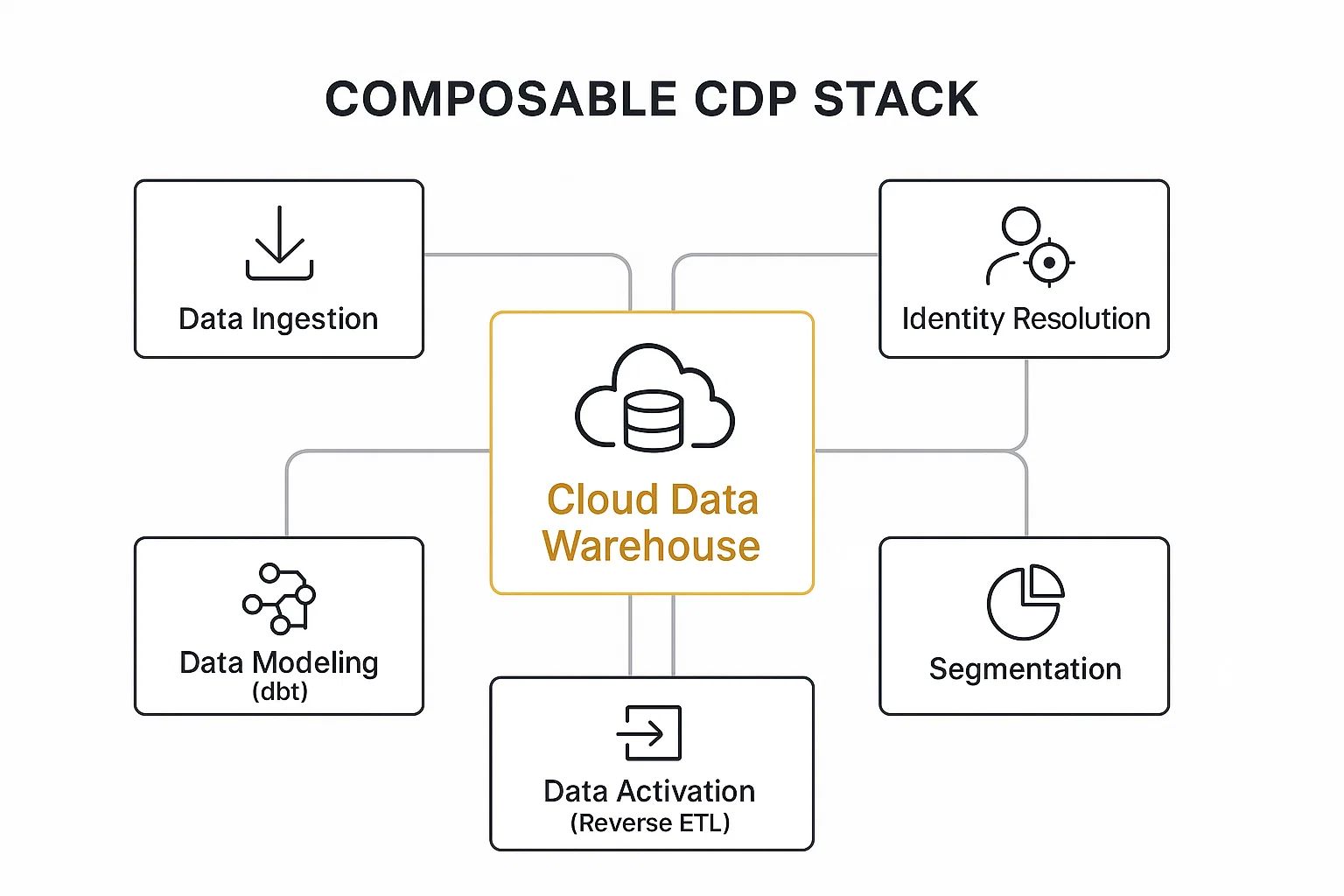
The Central Hub: Cloud Data Warehouse/Lakehouse: This is the non-negotiable core (Snowflake, BigQuery, Databricks, Redshift). It stores both raw and transformed data, serving as the single source of truth. All other components interact with it.
Building Blocks:
Data Ingestion/Collection: Collects data from various sources (websites, apps, CRM systems, and backend systems) and loads it directly into the warehouse. Tools may include ETL/ELT platforms (e.g., Fivetran, HighTouch), event streaming platforms (e.g., Snowplough, RudderStack), or vendor SDKs/APIs.
Data Storage and Modelling: This occurs within the warehouse. Data teams use SQL or tools to clean, transform, enrich, and model raw data into unified customer profiles (the "Customer 360").
Identity Resolution: Merges different identifiers for the same customer. This logic often runs directly within the warehouse using SQL, native features, or specialised tools, providing transparency and control.
Segmentation & Audience Management: Enables users (typically marketers via a user interface) to create target audiences by querying the unified data in the warehouse. Tools providing this layer often sit within activation platforms (e.g., Hightouch, Census, GrowthLoop, ActionIQ).
Data Activation: Sends unified data and audience segments from the warehouse to downstream engagement tools (email, ads, CRM, support). This is where Reverse ETL technology shines (e.g., Hightouch, Census, RudderStack, ActionIQ, DinMo ), enabling the syncing of warehouse data to operational systems.
Think of these as specialised modules working together, leveraging the power and data integrity of the central warehouse.
Navigating the Build: Challenges and How to Succeed
While the benefits are compelling, let's be realistic – implementing a composable stack isn't a plug-and-play solution. Acknowledging potential hurdles upfront with humility is crucial for success.
Be Prepared: Common Hurdles:
Integration Complexity: Juggling multiple tools and APIs requires technical skill to avoid a fragile "frankenstack".
Data Governance & Quality: Ensuring consistency and trust across disparate tools requires robust processes.
Skill Requirements: You need expertise in data engineering, cloud warehouses, APIs, and specific tools (such as dbt and reverse ETL platforms). Is your team ready?
Maintenance & Upgrades: Unlike packaged solutions, you own the upkeep of your integrations and components.
Organisational Alignment: This is often the most significant challenge! Collaborating effectively among IT, data, marketing, and other teams is vital, but it requires breaking down traditional silos.
Cost/Time Misconceptions: Don't underestimate the Total Cost of Ownership (TCO) or assume that initial use cases represent the full scope of the implementation effort.
Blueprint for Success: Best Practices: How can you navigate these challenges? Based on collective experience and expert recommendations:
Start with Clear Use Cases: Define specific business problems and desired outcomes first. Value drives the tech choices.
Adopt a Phased Approach: Don't boil the ocean. Use a "crawl-walk-run" strategy, starting with high-impact use cases on existing warehouse data.
Foster Strong Alignment: Secure executive buy-in. Promote collaboration across IT, data, and marketing from day one. Define roles clearly.
Invest In/Secure Skills: Honestly assess your team's capabilities. Plan for training, hiring, or partnering.
Prioritise Governance Early: Establish clear data definitions, quality checks, and access controls across the stack. Data catalogues help!
Choose Flexible Tools: Favour interoperable tools with strong APIs, perhaps aligning with MACH principles.
Leverage Existing Infrastructure: Build on your existing warehouse, rather than bypassing it.
Treat it Like a Product: Continuously monitor, optimise, and evolve the stack based on business needs and performance.
Successfully implementing a composable CDP requires a blend of technical expertise, strategic planning, and, crucially, a collaborative organisational mindset. It's an ongoing discipline, not just a one-time project.
Proof in Practice: Real-World Wins
The theory sounds promising, but does it hold up in practice? Absolutely. Leading companies across industries are achieving significant results with composable strategies:
Burberry (Luxury Retail): Built a real-time composable stack using Snowplough, Databricks, and AWS. This allowed them to bridge online browsing with in-store interactions, empowering advisors with timely insights and reducing data latency.
e.l.f. Beauty (Cosmetics): Leveraged ActionIQ on Databricks to unify data during a digital surge, leading to a 131% increase in acquired customers and a 25% lift in CLTV.
Accor Hotels (Hospitality): After struggling with traditional Customer Data Platforms (CDPs), they deployed Hightouch and had dozens of global teams executing campaigns within two months, effectively handling multi-brand complexity.
The common thread? Leveraging their existing data warehouse as a foundation to gain flexibility, speed, and drive measurable business outcomes tailored to their specific needs.
Looking Ahead: The Future is Composable
Reflecting on these trends and successes, the shift toward composable CDPs isn't just a fleeting trend; it signifies a deeper maturation in how we approach customer data.
Market Momentum: Analysts project strong growth, driven by the dominance of data warehouses, the critical need for first-party data strategies, the demands of AI and real-time engagement, and the ongoing pursuit of agility and cost efficiency. Some argue that composability will become a "mandatory requirement".
Evolving Role: Composable CDPs are moving beyond simple data syncing. They are becoming the intelligent activation layer connecting the warehouse (truth) to engagement channels. Expect more embedded AI for predictions and personalisation, improved real-time capabilities, democratised data access for business users, and orchestration across marketing, sales, and service.
Strategic Takeaways: What does this mean for your organisation's roadmap? Key considerations include:
- Assess Your Data Maturity: Is Your Warehouse Foundation Solid?
- Align with Business Goals: Let use cases guide your path.
- Embrace Collaboration: It's a team sport (IT, Data, and Business).
- Consider Total Cost of Ownership (TCO): Factor in skills, integration, and maintenance costs.
- Plan for Flexibility: Choose interoperable, warehouse-native tools.
- Start Smart, Iterate: Focus on quick wins and continuous improvement.
Summary
The customer data platform landscape is shifting decisively from rigid, monolithic systems to flexible, warehouse-centric, Composable CDPs. By leveraging your existing cloud data warehouse and combining it with best-in-class tools, this approach offers significant advantages in flexibility, scalability, cost efficiency, speed, and data governance. While implementation requires careful planning and collaboration, the composable model represents a more integrated, robust, and future-proof approach to activating customer data and driving meaningful engagement across the modern enterprise.
Related Posts
Vibe Coding Is Not About the AI. It's About You
Better prompts were never the answer. Better thinking was. The 4 human skills that separate builders who ship from builders who spiral.
Read more →3Cs of Customer Engagement: Customer, Channel, and Communication
Explore the 3Cs framework (Customer, Channel, Communication) for building stronger customer relationships, powered by essential Measurement & Governance.
Read more →