

Designing Effective Modern Marketing Organizational Structures
Explore modern marketing org structures, key roles, challenges, AI's impact, and a framework for strategic design.
Summary Points
- Agile, customer-centric models replace silos. Balance specialization with integration via matrix/pod approaches
- New focus on data analytics, CX, and MarTech alongside traditional functions. T-shaped marketers bridge gaps
- Avoid misalignment, poor change management. Address tech integration, data overload, and talent gaps strategically
- AI reshapes roles (prompt engineers), automates tasks, enables personalization, but requires new governance
Reading time: 8 minutes
Introduction: Structure as Strategy - Beyond the Org Chart
How your marketing team is organized isn't just about drawing boxes and lines on a chart. It's a fundamental strategic decision that can significantly determine your success or failure in today's marketplace. A well-designed structure acts as an accelerator, while an outdated one becomes an anchor, dragging down performance.
We've moved far beyond the days when marketing operated in relative isolation, focused mainly on the traditional "Four Ps." Today's marketing is a complex, integrated function deeply woven into the entire customer experience. Outdated structures often lead to silos, miscommunication, and an inability to adapt, while modern demands – driven by digital transformation, complex customer journeys, the need for data-driven insights, and intense pressure to show ROI – cry out for new, more agile approaches.
This post navigates the labyrinth of modern marketing organizational design. We'll explore the forces driving change, examine common structural models, identify the key roles needed today, discuss common challenges and pitfalls, look at future trends like AI, and outline a strategic approach to designing a structure that truly empowers your marketing efforts.
The Forces Reshaping Marketing Teams
Why the urgent need to rethink marketing structures? Several powerful forces are converging:
Digital Transformation: The explosion of digital channels (web, social, mobile, etc.) creates complex ecosystems that demand integrated management and omnichannel strategies.
Data-Driven Imperative: Marketing now relies heavily on data analytics for insights, personalization, and performance measurement. Structures must embed strong data capabilities.
Customer Journey Complexity: Buyers navigate non-linear paths across numerous touchpoints. Marketing needs structures aligned with supporting this complex journey.
Personalization Demands: Customers expect relevant, tailored experiences, requiring sophisticated data use and potentially segment-focused teams.
ROI Accountability Pressure: Marketing must demonstrably contribute to the bottom line, requiring structures that facilitate clear measurement and reporting.
Remote/Hybrid Work & Talent Needs: The rise of distributed teams and the need for new hybrid skill sets (creative + analytical + technical) also influence structural choices.
These drivers point towards a fundamental shift from channel or product focus to a deeply customer-centric orientation, demanding more adaptable and integrated organizational designs.
Foundational Blueprints: Common Marketing Org Models
While every organization's ideal structure is unique, several foundational models provide starting points. There's no single "best" answer; the optimal choice depends on factors like company size, industry, goals, and culture.
1. Functional Structure
Definition: Teams organized by specialized expertise (e.g., SEO, Content, Social).
Pros: Deep expertise, clear reporting, efficient functions.
Cons: Silos, poor collaboration, slow decisions, fragmented CX.
Best Fit: Large orgs needing specialization (with strong integration).
2. Product-Based Structure
Definition: Teams aligned to specific products/lines.
Pros: Product champions, tailored marketing, faster product decisions.
Cons: Duplicated efforts, brand inconsistency, cross-selling barriers.
Best Fit: Companies with diverse product portfolios.
3. Segment-Based Structure
Definition: Teams focused on customer segments (B2B/B2C, geo).
Pros: Deep customer insight, personalization, segment responsiveness.
Cons: Duplicated resources, potential brand fragmentation.
Best Fit: Orgs with diverse customer segments.
4. Matrix Structure
Definition: Dual reporting (functional + product/segment).
Pros: Balances specialization/collaboration, flexible resources.
Cons: Complex, conflicting priorities, slower decisions.
Best Fit: Large, cross-functional orgs (e.g., enterprise).
5. Agile Structure
Definition: Cross-functional teams in iterative sprints.
Pros: Adaptable, fast, collaborative, data-driven, empowering.
Cons: Cultural shift needed, unpredictable timelines, high overhead.
Best Fit: Dynamic environments
The trend is clearly towards models that break down silos and foster integration – Matrix, Agile, or even Hybrid structures are gaining prominence as companies strive for greater responsiveness and customer-centricity.
Anatomy of the Modern Marketing Engine: Key Roles
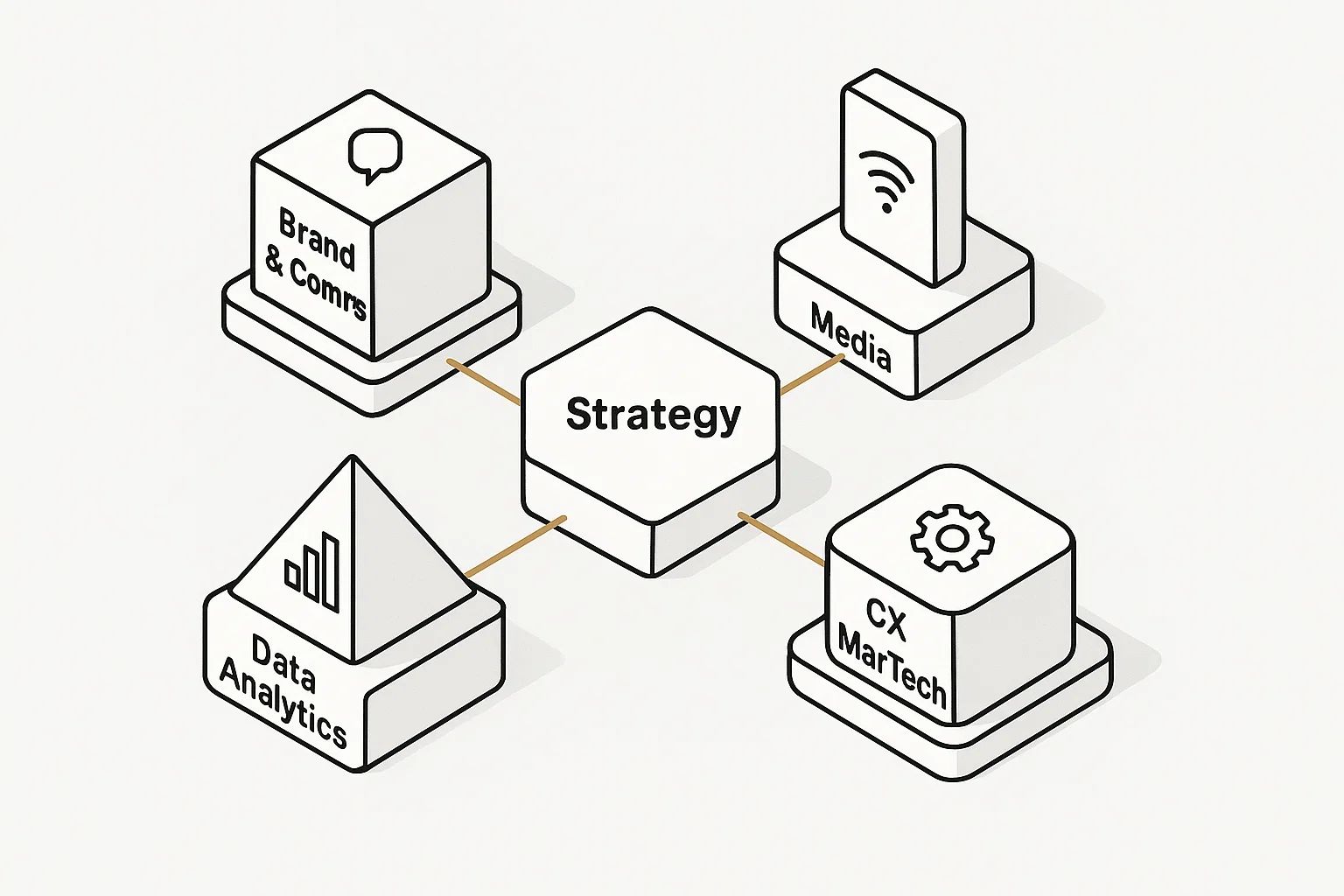
Modern marketing often benefits from integrated, cross-functional teams or "pods," designed to break down silos and enhance collaboration towards specific goals. These pods typically focus on holistic strategy execution and customer experience, integrating various specialized functions. Key areas of responsibility within such an integrated structure include:
1. Marketing Strategy & Integration
Holistic Strategy Development: Creating overarching marketing strategies aligned with business objectives; leading and coordinating across functions for a unified approach.
Integration Responsibility: Ensuring seamless integration across marketing functions, removing communication and channel silos for a single brand voice.
Research & Positioning: Conducting research to inform offering development and market positioning.
Pod Coordination: Managing and coordinating cross-functional marketing pods for optimal performance.
Product/Business Ownership: May include ownership of specific product lines or business areas within the marketing scope.
2. Brand, Communication & Partnerships
Brand Positioning & Ownership: Defining and maintaining the brand's market position.
Content Marketing & Customer Education: Developing strategies to educate customers and build brand authority.
Integrated Communications & Creative: Managing communication, creative development, and copywriting across all channels (brand, always-on, tactical) for consistency.
Partnerships & PR: Building strategic partnerships and managing press relations.
3. Media
Omnichannel Media Strategy: Planning and executing campaigns across offline and online media (paid, owned, earned).
Channel Management: Overseeing specific channels like paid social, SEO, paid search, offline media, and physical points of presence (branches, ATMs).
Media Efficiency & Optimization: Driving efficiency in media spend and optimizing reach (prioritizing owned channels).
Social Presence & Communication: Managing the brand's voice and engagement on social media platforms.
4. Data & Analytics
Campaign Measurement & Marketing Analytics: Measuring campaign effectiveness, tracking KPIs, and providing performance insights. Includes digital and potentially sales analytics.
Customer Analytics: Analyzing customer data for segmentation, behavior understanding, and personalization.
Research: Conducting market and customer research.
Data Governance & Enrichment: Managing internal/external data sources, ensuring quality, and enriching profiles.
Sales & Incentive Management: Designing, managing, and analyzing sales incentive structures.
5. Customer Experience & Marketing Technology
Holistic CX Management: Driving a unified customer experience across touchpoints (website, app, social, WhatsApp, chatbots, fulfillment/D2C).
CCO Offering & Positioning: Managing Chief Customer Officer related offerings and positioning.
CX Strategy & Optimization: Leading UI/UX efforts focused on cross-selling, upselling, segmentation, loyalty, and retention.
Customer Query Management: Handling customer inquiries across various channels.
MarTech Integration & Management: Bridging Marketing and Technology; overseeing the MarTech stack (CRM, CDP, automation) to enable personalisation and efficiency. (Note: Technology implementation may reside elsewhere.)
Key Shifts:
Notice the significant growth in roles focused on digital channels, data analysis, and operations (MarOps/RevOps). These reflect the technological sophistication and accountability demands of modern marketing. There is also an increasing value placed on "T-shaped" marketers, who possess deep expertise in one area and a broad understanding across others, facilitating better collaboration.
Common Hurdles and Implementation Traps
Even with the right roles, marketing teams face challenges, and restructuring efforts often stumble.
Operational Challenges Modern teams frequently grapple with:
Budget Constraints & ROI Justification: Constant pressure to prove value and secure funding.
Technology Integration: Managing a complex, often disconnected MarTech stack.
Data Overload: Drowning in data but struggling to extract actionable insights.
Cross-Functional Collaboration: Poor communication/alignment with Sales, IT, and Product.
Change Management: Resistance to adopting new tools, processes, or structures.
Talent Gaps: Difficulty finding/retaining talent with the right modern skill mix.
Reorganisation Pitfalls: Avoid these common mistakes when changing structures:
Misalignment with Strategy: Restructuring without a clear, sound strategy.
Poor Communication: Failing to explain the 'why' and 'how' transparently and consistently.
Ignoring Culture & Resistance: Underestimating the impact of existing norms and employee concerns.
Lack of Stakeholder Buy-in: Failing to involve those affected in the planning process.
Focusing Only on Structure: Neglecting underlying processes, capabilities, and workflows ('the white space').
Poor Planning/Execution: Rushing, insufficient resources, unrealistic expectations.
Successfully restructuring requires more than simply redrawing charts; it's a complex change management process that demands strategic alignment, clear communication, stakeholder engagement, and attention to underlying processes and culture.
The Future is Now: AI and Other Trends
The marketing landscape continues to evolve rapidly. AI's Transformative Impact Artificial Intelligence is no longer hype; it's actively reshaping marketing by:
- Enhancing Capabilities: Improving forecasting, enabling hyper-personalisation at scale, powering chatbots.
- Automating Tasks: Handling routine analysis, content drafting, and spend optimisation.
- Demanding New Skills/Roles: Requiring AI specialists, prompt engineers, AI ethicists, and upskilling for collaboration.
- Influencing Structure: Potentially enabling flatter organisations as AI handles coordination, but requiring new governance for risks (privacy, bias, IP).
- Changing Customer Interaction: Shifting content strategy focus as users interact with AI assistants for research.
Conclusion: Structure is Strategy in Motion
Your marketing organisation's structure is far more than an administrative detail; it's a dynamic reflection of your strategy and a critical enabler of success. As digital transformation, data demands, and customer expectations reshape the landscape, rigid, siloed structures are proving inadequate. The shift towards more integrated, agile, and customer-centric models is evident.
However, there's no one-size-fits-all solution. The "right" structure depends entirely on your unique business context – your goals, resources, culture, and market. Designing it requires thoughtful assessment and strategic alignment.
Crucially, remember that the blueprint itself is only part of the equation. The success of any structural change hinges on the quality of implementation and change management. Effective leadership, clear communication, employee engagement, and a focus on underlying processes and capabilities are what truly bring a structure to life.
View your marketing organisation not as a static chart, but as a dynamic system requiring continuous evaluation and adaptation. By embracing thoughtful design and effective change management, you can build a marketing engine that navigates complexity and drives sustainable growth.
Related Posts
Reward-Tightrope: Balancing Loyalty and Talent in an Organization
A tailored 'Total Rewards' strategy can help you find the Balance Loyalty and Talent in Your Organization
Read more →Empathetic-Edge: Driving Leadership Success Through Understanding and Connection
Empathy isn't just a 'soft skill' – it's a strategic leadership advantage. Understanding and connection drive trust, performance, innovation, and retention.
Read more →