

Google-Ads Evolution: Adapting to Social Habits and the Conversational AI Shift
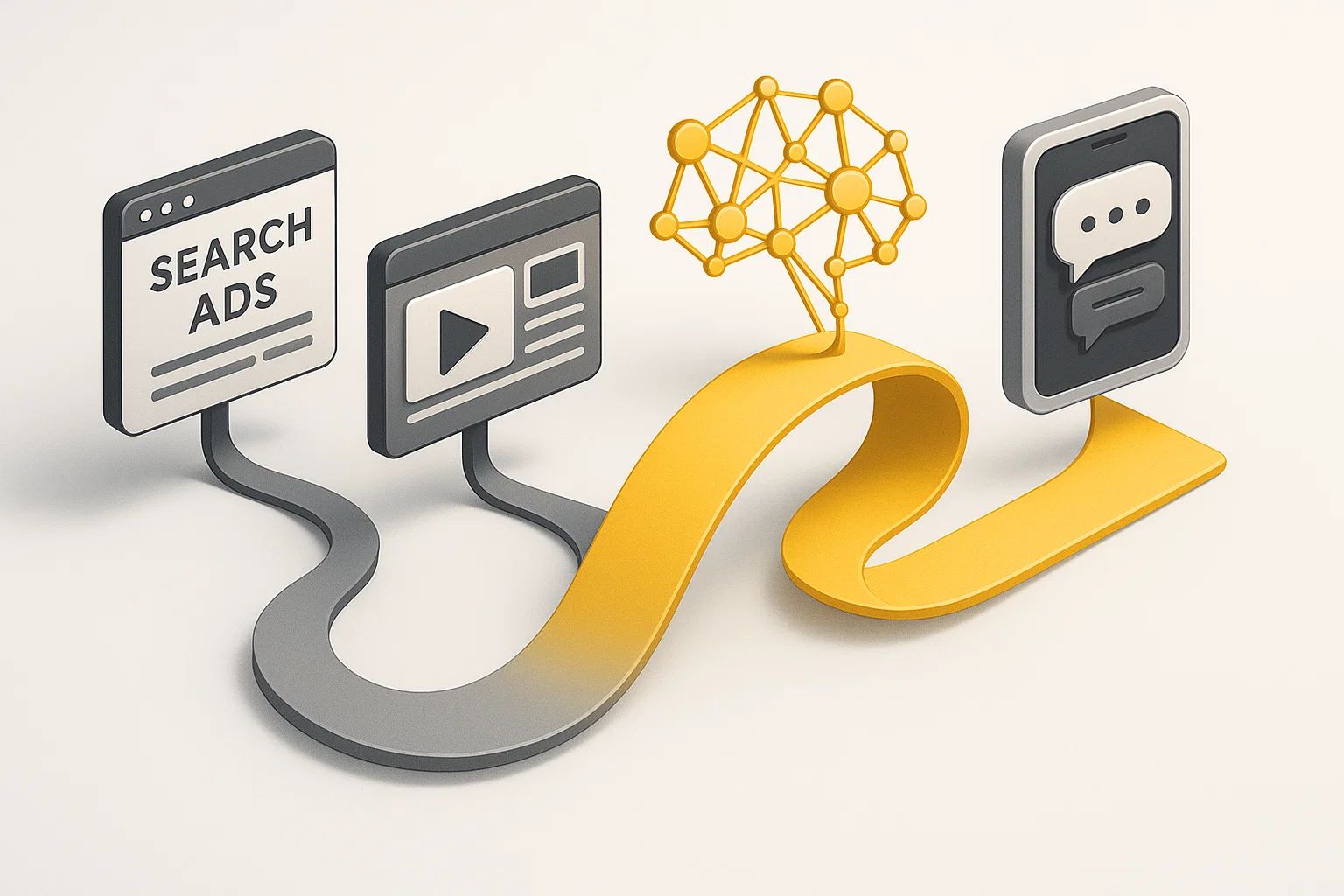
Google Ads is evolving beyond keywords, driven by social media habits and the rise of conversational AI.
Summary Points
- From Keywords to AI (2000s-Now): Google Ads evolved from PPC/keyword focus to AI-driven automation
- User Behavior Shifts: Social feeds & conversational AI (ChatGPT) demand visual, contextual, & chat-based ad formats
- Advertiser Adaptation: AI tools, audience signals, adaptive creatives, & conversational search prep for future success
Reading time: 4 minutes
Google Ads Milestones: From Keywords to Early AI Integration
The Keyword Foundation (Early 2000s)
Launch: Google AdWords was introduced in 2000 (initially based on CPM).
PPC Revolution (2002): Shift to Pay-Per-Click, emphasising relevance (Quality Score added 2005).
Core Model: Match text ads directly to explicit keyword search queries. Keywords ruled.
Expanding the Reach (Mid 2000s - Early 2010s)
Google built inventory beyond search:
GDN (2005): Ads on partner sites.
YouTube Acquisition (2006): Dominance in video.
DoubleClick Acquisition (2007): Enhanced display tech.
Shopping Ads: Visual product listings.
Mobile Adaptation (Enhanced Campaigns, 2013): Addressing multi-device use.
The Dawn of AI and Automation (Mid 2010s - Present)
AI/ML became central to managing complexity and understanding intent beyond keywords:
Smart Bidding (2016): AI automates bids based on many signals.
Responsive Search Ads (RSAs): AI mixes/matches headlines/descriptions (default from 2022).
Performance Max (PMax, 2021): AI orchestrates campaigns across all Google inventory using audience signals and creative assets.
Discovery/Demand Gen (2019/2023): Visually-driven campaigns for feed environments (YouTube, Discover, Gmail) targeting users before search.
Rebrand (2018): AdWords becomes Google Ads, reflecting broader scope.
AI as the Engine: Essential for personalization and cross-channel delivery based on richer user signals.
The User Behavior Drivers: Social Feeds & Conversational AI
Google's AI evolution responds directly to how we changed our online habits.
Influence 1: Social Media Habits
Social platforms rewired expectations:
Visual Dominance: Accustomed to image/video-heavy feeds, especially short-form vertical video (TikTok, Reels, Shorts); shorter attention spans.
Feed & Passive Discovery: Learned to scroll passively, discovering content/products serendipitously.
Mobile-First Interaction: Vertical viewing, thumb-scrolling, horizontal swiping became default mobile behaviors.
Influence 2: The Rise of Conversational AI
Tools like ChatGPT and Gemini introduced further shifts:
Keywords to Questions: Users ask full questions, not just keyword strings.
Dialogue-Based Discovery: Information seeking becomes a back-and-forth conversation.
Changing Expectations: Desire for direct, synthesized answers within chat interfaces, potentially bypassing traditional SERPs.
New Intent Signals: Conversations provide richer (but different) signals than keywords alone, challenging traditional analysis.
Google's AI-Powered Response: Ads for the New Era
Google leverages AI to adapt its ad offerings.
Demand Gen & PMax: Reaching Users Contextually
These campaigns are key tools for the new landscape:
Beyond Keywords: Rely on audience signals and creative assets, letting AI target based on context and broader intent.
Visual & Feed-Ready: Designed for visual engagement in feed environments (YouTube, Discover), mimicking social consumption.
AI Orchestration: AI matches creative, audience, and platform automatically based on goals.
Significance: Represent Google using AI to engage users holistically, moving beyond keyword dependency.
SGE / AI Overviews: Ads Within the Conversation
The Change: Google integrates AI-generated summaries directly into search results.
The Adaptation: Ads are being tested within or alongside these AI summaries.
The Goal: Keep ads relevant and visible even as the traditional "blue links" format potentially diminishes for some queries. It's about staying part of the conversational search experience.
The AI Horizon: Predicting Google Ads' Future
Where might AI take Google Ads next? (Informed speculation):
Prediction 1: Deeper Contextual Understanding: AI grasping nuanced intent from conversations, browsing, etc., for even more sophisticated targeting.
Prediction 2: More Automated & Generative Creative: Increased AI power in generating and optimizing diverse ad creatives (text, images, video), shifting advertiser focus to strategy/oversight.
Prediction 3: Conversational Ad Formats?: Potential for new ad types within AI chat experiences (e.g., sponsored suggestions, interactive dialogues).
Prediction 4: Evolving Measurement: Shift from last-click towards AI-driven attribution models valuing complex, cross-channel journeys.
Prediction 5: Shifting Marketer Skills: Greater need for prompt engineering, AI collaboration, strategic oversight, data interpretation, and creative direction skills.
Advertiser Implications: Navigating the AI-Driven Shift
Advertisers must adapt to this evolving landscape:
Master AI-Driven Campaigns NOW: Proficiency in PMax/Demand Gen is crucial. Provide strong audience signals, first-party data, and diverse, high-quality creative assets.
Focus on Audiences & Context: Shift from exhaustive keyword lists to deep audience understanding and contextual relevance. Leverage all signals.
Develop Adaptive Creative: Invest in compelling visuals (multiple ratios) AND concise, impactful text suitable for various AI-driven formats (feeds, summaries, potential conversations).
Prepare for Conversational Search: Optimize web content for natural language questions. Monitor ad performance within SGE/AI Overviews closely.
Embrace AI Tools: Experiment with Google's AI creative features, but maintain brand oversight and review outputs.
Adopt Advanced Measurement: Move beyond last-click. Understand lift studies and explore data-driven attribution.
Upskill Your Team: Train for AI collaboration, data interpretation, strategic oversight, and creative direction for AI.
Conclusion: Advertising in the Age of AI & Evolving Habits
Transformation: Google Ads has moved far beyond keywords, driven by user behavior shifts (social, then conversational AI).
AI is Core: AI is the engine enabling Google's adaptation (PMax, Demand Gen, SGE) and shaping its future. It allows for contextual targeting and cross-ecosystem delivery.
Advertiser Adaptation is Key: Success requires embracing AI-driven campaigns, focusing on audience and context, creating adaptive visuals and text, preparing for conversational interactions, and evolving measurement approaches.
The New Reality: Continuous learning and strategic adaptation to AI and user behaviour are essential for future Google Ads success. The conversation is evolving, and so must our strategies.
Related Posts
Product Packaging Perfection: Why the Box (and What’s Inside) Counts
Packaging is more than just a box – it's the first impression, a silent salesperson, and a critical part of what makes a product feel good.
Read more →Adapting to Short Attention & Digital Shifts
Customer engagement is undergoing a paradigm shift. Explore 4 critical behavioural changes plus strategies for adapting.
Read more →