

Power of Three in Communication
Discover the Rule of Three: Powerful communication principle rooted in cognitive psychology & cultural tradition. Learn how to apply it for effective messaging.

Summary Points
- Why Three Works: Triads align with cognitive limits and cultural patterns, making messages clearer and more memorable
- Brain Science: We process 3-5 items best; triads reduce mental strain and feel naturally balanced
- Timeless Tool: Used since ancient rhetoric (Aristotle) to modern ads ("Stop, Drop, Roll"), proving universal appeal
- Use Wisely: Avoid oversimplifying complex topics. Three is a guide, not a rule—balance clarity with nuance.
Reading time: 9 minutes
Introduction: Why Three is More Than Just a Number
Have you ever noticed how often things seem to come in threes? Think about standard instructions ("Ready, Set, Go!" or "Stop, Drop, and Roll"), familiar concepts ("Past, Present, Future"), or even simple marketing slogans ("Reduce, Reuse, Recycle"). It’s not just a coincidence; it's often the deliberate use of the "Rule of Three," a powerful and enduring communication principle.
This isn't just a matter of arbitrary preference. The Rule of Three has deep roots in how our brains process information and how our cultures have evolved to share ideas effectively. It’s a technique that leverages psychology and tradition to make messages more straightforward, more memorable, and more persuasive.
In this post, we'll explore why this simple rule is so effective by looking at its cognitive and cultural foundations. We'll see how it's applied across various fields, such as public speaking, marketing, and education. And finally, we'll examine how you can strategically utilise frameworks based on this rule, while also being mindful of their limitations.
The Science Behind Threes: How Our Brains Are Wired
The Magic Number Isn't Seven (or is it?)
Why does grouping things in threes work so well? A big part of the answer lies in the limits of our minds, specifically our working memory. You might have heard of George Miller's famous 1956 paper suggesting we can hold about "seven, plus or minus two" pieces of information in our short-term memory. It’s a fascinating idea, but later research, especially when dealing with new or complex information, suggests our functional capacity is often much smaller, closer to just three to five items.
Think of your working memory like a mental juggling act. It has to both hold onto information and process it simultaneously. This creates what psychologists refer to as "cognitive load." Try to juggle too many balls (or pieces of information), and you'll inevitably drop some. According to Cognitive Load Theory, when we're overloaded, our ability to understand and remember suffers.
The Rule of Three cleverly sidesteps this limitation. By structuring information in triads, communicators reduce the mental strain (the extraneous load), allowing the audience to dedicate their cognitive resources to understanding and integrating the information (the germane load). Presenting three key points is often the sweet spot, providing enough substance without being overwhelming.
Pattern Seekers: Why Triads Feel 'Right'
Beyond memory limits, humans are fundamentally pattern-seeking creatures. We look for structure and order everywhere. Groups of three satisfy this innate tendency beautifully. They provide a sense of balance, rhythm, and completeness.
Think about basic structures: beginning, middle, end. Problem, solution, benefit. These triadic patterns feel resolved and whole. This psychological satisfaction is reinforced from childhood. We grow up with stories built around three characters or events, and we hear powerful ideas delivered in threes ("Life, Liberty, and the Pursuit of Happiness"). Our culture constantly teaches us that three is a natural and effective way to organise information.
Some even suggest that triads hit a neurological "sweet spot," activating the brain's reward centres by offering a predictable yet engaging structure – not too simple, not too complex. It helps explain why three-part jokes land, three-act plays feel complete, and three-step instructions are easy to follow.
A Timeless Trio: The Rule of Three Through History
Ancient Roots: Rhetoric and Religion
The power of three isn't a modern discovery. Its origins stretch back to ancient rhetoric. Aristotle, in his analysis of persuasion, identified three key appeals: ethos (credibility), pathos (emotional appeal), and logos (logical appeal). The Romans had a saying, omne trium perfectum – "everything that comes in threes is perfect."
Roman orators mastered the tricolon, a structure using three parallel clauses or sentences for emphasis. Think of Julius Caesar's reported "Veni, vidi, vici" (I came, I saw, I conquered) or, much later, Abraham Lincoln's powerful description of democracy: "government of the people, by the people, for the people."
The Rule of Three also holds deep significance in religious traditions worldwide, often symbolising divinity, wholeness, or fundamental principles: the Holy Trinity in Christianity, the Three Jewels of Buddhism (Buddha, Dharma, Sangha), the Trimurti in Hinduism (Brahma, Vishnu, Shiva). These examples demonstrate how triads have long been employed to convey profound concepts in a clear and accessible manner.
Modern Echoes: Media, Marketing, and Memes
Fast forward to today, and the Rule of Three is alive and well. It’s everywhere, often used so naturally we barely notice:
Advertising: Think of straightforward, memorable campaigns, such as "Reduce, Reuse, Recycle" or the classic road safety mantra, "Stop, Look, Listen."
Branding: Even breakfast cereal gets in on the act with "Snap, Crackle, Pop."
Politics: Slogans often rely on triads for punchiness, like "Education, Healthcare, Jobs."
Digital Design: Look closely online. Blog posts often break main points into three subheadings. Social media captions might highlight three key benefits. Infographics frequently group data points into threes.
This enduring presence across different times and fields shows a widespread, almost intuitive understanding that structuring information in threes makes it more engaging and easier to grasp.
Putting Three to Work: Practical Applications
Knowing the why and the history is fascinating, but the real value lies in learning how to use the Rule of Three effectively. Let's look at some typical applications.
Speaking to Persuade: Presentations and Pitches
Effective public speakers often lean heavily on the Rule of Three. A common and highly effective structure follows the adage: "Tell them what you’re going to tell them, tell them, then tell them what you told them." This often translates to:
Introduction: State your objective and outline the three main themes you'll cover. ("Today, I'll discuss three key strategies for improving team collaboration.")
Body: Elaborate on each of the three themes in sequence, providing details and evidence.
Conclusion: Summarise the three themes and reinforce your main message.
This structure works partly because of the serial position effect – the psychological tendency for people best to remember the first and last items in a series. By introducing and summarising your three points, you significantly boost the chances that your audience will retain them.
Marketing That Sticks: Branding and Messaging
In marketing, clarity and memorability are paramount. The Rule of Three helps cut through the noise by simplifying complex value propositions. Think of Apple’s classic product descriptions, such as "Faster, Lighter, Thinner." It’s instantly understandable and highlights key benefits concisely.
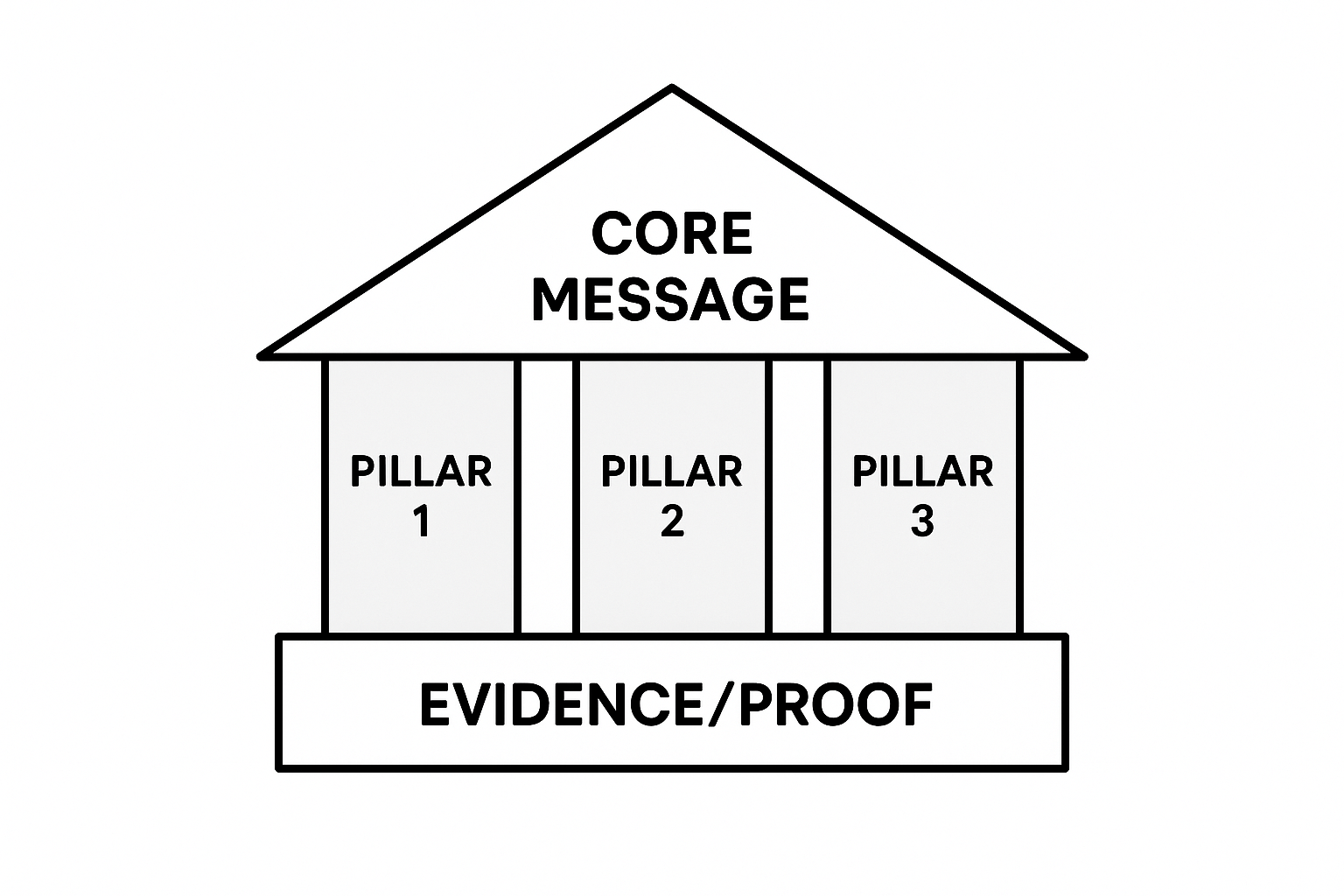
A more strategic application is the Message House framework, which is often used in corporate communications and public relations. It organises key messages into:
The Roof: Your single, overarching core message.
The Pillars: Three key supporting arguments or themes that validate the core message.
The Foundation: Specific proof points, data, or examples that underpin each pillar.
This ensures a clear, memorable, and evidence-based structure consistently supports your core message.
Teaching for Clarity: Education and Instruction
Educators intuitively use the Rule of Three to make learning more manageable. Breaking down complex subjects into smaller, more digestible chunks aligns perfectly with how our brains learn most effectively. For example, teaching a concept might involve:
Defining three clear learning objectives.
Explaining the idea using three different examples or analogies.
Reinforcing the learning with three practice activities or review questions.
Consider teaching photosynthesis. It can be broken down into three core components:
Inputs: Sunlight, Water, Carbon Dioxide
Process: Light-Dependent Reactions, Calvin Cycle (Okay, maybe two key stages here, but often simplified or grouped)
Outputs: Glucose, Oxygen
Structuring lessons this way directly applies Cognitive Load Theory – minimising extraneous information allows students to focus their mental energy on understanding the core concepts.
Frameworks for Strategic Triads
Beyond general applications, specific frameworks can help you implement the Rule of Three more deliberately.
Building Your Message House
Let's revisit the Message House model. It’s a practical blueprint:
Roof: Start with the single most important takeaway you want your audience to remember. (e.g., "Our new software dramatically boosts team productivity.")
Walls/Pillars: Develop three distinct arguments or benefit categories that support the roof. (e.g., 1. "Streamlines communication," 2. "Automates repetitive tasks," 3. "Provides real-time progress tracking.")
Foundation: For each pillar, gather concrete evidence, data, testimonials, or examples that prove its validity. (e.g., Under Pillar 2: "Beta testers reported a 40% reduction in time spent on manual data entry.")
This framework fosters discipline and ensures your message is clear, well-supported, and easy for others to understand and repeat.
The Three-Angle Approach
People learn and are persuaded in different ways. To broaden your impact, consider presenting key ideas through three distinct lenses:
Analytical: Appeal to logic with data, statistics, facts, and structured arguments.
Emotional: Connect through storytelling, anecdotes, case studies, and appeals to values or aspirations.
Practical: Provide clear, actionable steps, how-to guides, demonstrations, or tangible examples.
For instance, discussing climate change action could involve showing temperature trend graphs (Analytical), sharing a story of a community affected by rising sea levels (Emotional), and offering specific energy-saving tips for households (Practical). Addressing these different angles makes your message more resonant and persuasive for a wider audience.
The Power of Repetition
Sometimes, simply repeating a key point three times across a communication piece can significantly enhance recall. This isn't about mindless repetition, but strategic reinforcement:
Introduce the point.
Elaborate on it with details or evidence.
Summarise or refer back to it later.
This leverages the mere exposure effect, where familiarity tends to increase positive feelings or acceptance. Think of how politicians often repeat key phrases or policy names throughout a speech or debate.
When Three Isn't the Charm: Caveats and Considerations
While powerful, the Rule of Three isn't a magic wand. It's a tool, and like any tool, it has limitations and potential downsides:
Risk of Oversimplification: Forcing complex, nuanced topics into exactly three points can sometimes feel reductive or superficial. Issues such as global economics or advanced scientific concepts require more detailed exploration.
Audience Scepticism: If used too formulaically or obviously, audiences might perceive the structure as manipulative rather than helpful. It can sometimes come across as overly slick or lacking authenticity.
Cultural/Contextual Nuances: While familiar, the preference for three isn't universally absolute. Some high-context cultures might favour more indirect or holistic communication styles. Highly technical or academic fields often demand exhaustive detail that goes beyond simple triads.
Balancing Structure and Creativity: Strict adherence can sometimes stifle creativity or prevent a more natural flow of ideas. Truly iconic communication, like Martin Luther King Jr.'s "I Have a Dream" speech, often uses repetition and rhythm in ways that transcend simple formulas. Don't let the rule become a creative straitjacket.
Conclusion: Three as a Tool, Not a Mandate
So, is three a magic number? Not exactly. But the Rule of Three is undeniably a potent strategic tool in the communicator's kit. Its effectiveness stems from a profound harmony between the natural limits of our cognition and the patterns ingrained in our culture.
By consciously structuring messages into triads – whether it's points in a presentation, benefits in a marketing pitch, or steps in a tutorial – we can significantly enhance clarity, boost memorability, and increase persuasiveness.
The key takeaway is to use the Rule of Three thoughtfully. Understand why it works and apply it where it makes sense, but don't feel rigidly bound by it. Balance its structural benefits with the need for nuance, authenticity, and creativity. When used wisely, the power of three offers a timeless framework for cutting through the noise and making your message resonate. How might you use it in your subsequent communication?